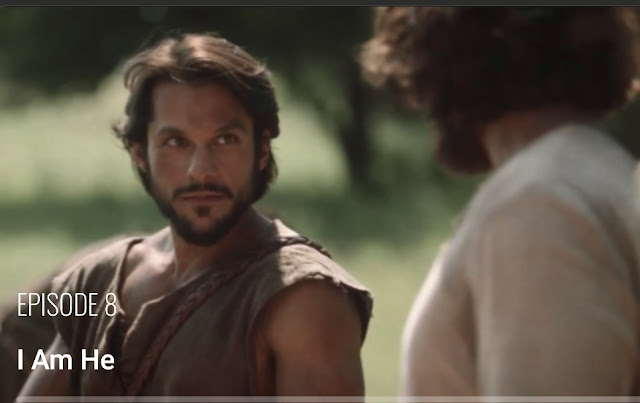
Watch this episode for free.
This episode begins in 1952 B.C. with the patriarch Jacob instructing his sons where to dig for a well. While they dig, Jacob greets a man he sees approaching them, saying, Shalom, explaining it is a greeting of peace. "You won't find much of that here," says the man, Yassib. Jacob says to him, "I would offer you something to drink, but as you can see, we have just begun work on our well." Yassib guesses, "You bought this land from the sons of Hamor?" "Yes," says Jacob, "would you believe for only 100 pieces of money?" (Genesis 33:17-20). Yassib says, "I believe it every time the princes of this land cheat another foreigner. You will never strike water. The recent rain makes the land look lush, but the underground river runs around the mountain, not up it."


Jacob, looking up, tells him, "Our God takes care of us." Gloomy Yassib replies, "This is Canaan. The gods are not nice here." Jacob explains, "We are sojourners, looking for a land our God promised my grandfather, Abraham." Yassib, considering that, says, "You ever notice how the gods are always promising us things, but we never see them happen?" Jacob observes, "Sometimes it takes generations." "Suit yourself," says Yassib dismissively. "So what is this god of yours called anyway?" "El Shaddai," answers Jacob. "I've never heard of Him," says Yassib. "Not many people have," says Jacob, "but I think someday they will." "Where's your temple for this god?" wonders Yassib. "He has no temple. We build altars wherever we go," answers Jacob. "There are no carved idols of Him." "So He's invisible?" concludes Yassib. Jacob tells him that is true, but says there was one time when God appeared in the flesh to wrestle with him, and dislocated his hip (Genesis 32:22-32).


This is too much for Yassib, who says, "I've heard enough! Of all the gods you cold possibly choose from, you pick an invisible God whose promises take generations to come true, who makes you sojourn in strange places, and He dislocated your hip? That is a strange choice." "We didn't choose Him," Jacob tells him. Just then his sons call out: "Father!" Both older men come running. Inside the hole the younger men have dug a spring of water is gurgling. Jacob smiles as he turns to Yassib and explains, "He chose us."
 |
| Jacob: He chose us, not the other way around. |
At that same location about 2,000 years later, in A.D. 26, by a town now known as Sychar, a lone woman laboriously draws water from a well (John 4). When done, she braces herself to carry two heavy stone water vessels connected by a thick pole to the distant town.


After the woman finally reaches her destination, she sets the pole with the jugs on a brace and catches her breath. When she enters the house, we see an old man sitting by a fire. He tells her, "When the door opened, I honestly hoped it was a thief or a murderer come to put me out of my misery." "Sorry to disappoint you," says the woman, "but there's something I need from you first." He coughs and says, "Come closer. I can't see you." When she does, he observes that her hair is matted and her face is red, asking why. The woman answers, "You know why." He tells her, "If you came back to live with me, you could go to the well with the other women in the cool of the morning." She tells him, "You're wrong about that. I could go with them if I had stayed with Ramin."


Losing patience, the old man states harshly, "Out with it: how much do you need?" The woman tells him, "I'm not here for money. I've brought a bill of divorce. All you need to do is sign it." He tells her firmly, "Only a man can divorce his wife, not the other way around, Photina." "Which is why the certificate is in your name, Neriah," says Photina. "On what grounds am I to divorce you?" asks Neriah. "I'm living with another man," states Photina. "So what?" says Neriah. "That's all you did with me: live here." She points out that he knew she married him for stability, and it becomes clear from their tense conversation that she was married to and divorced from other men before him. After looking at the divorce paper, Neriah tosses it into the fire and tells his wife coldly, "You are my property, Photina, and I don't part lightly with my possessions."


Matthew the former tax collector is at his house, proving to be a gracious host to Jesus, fellow disciples, and others gathered with them. They are laughing together as they share stories. Rivka, Mary Magdalene's former landlord, tells how Nicodemus was practically tripping on his robes as he ran from the Red Quarter after failing to cast demons out of Mary. Blind Shula quips, "A Pharisee running? Somehow I can't see that." That promotes a belly laugh from her friend Barnaby, who says to his host passing out grapes, "You know, Matthew, when you're not behind iron bars, you're quite handsome." "I agree!" says Rivka. Matthew blushes, but seems to enjoy having friends now.
 |
A lavish party at Matthew's house.
 | | Jesus sitting next to Shula, a blind woman. |
Rabbi Yussif and another Pharisee walking by hear their voices outside the window and presume to ask, "What is going on here?" Matthew opens the door and politely asks them, "May I help you?" Yussif says, "We were just on a walk and we heard voices, and I thought it sounded like ... but surely not!" Jesus now stands near Matthew and asks warmly, "Would you like to come in?" Yussif, shocked, says, "We would never be caught dead in ..." "What, a tax collector's house?" asks Jesus. "Not only that," says Yussif, "but also ..." Simon observes that he seems to be having trouble finding words to criticize everyone in that house about something. |
 |
Matthew sees who is at the door.
 | | Jesus is welcoming. |
Yussif does find the words to ask this question: "Why does your Master eat with tax collectors and sinners?" The Lord Jesus explains simply, "It is not the healthy who need a doctor, but the sick." Yussif tells Him, "I must say I am shocked: she (pointing to a woman at the table) is from the Red Quarter! Much of what is done there cannot even be spoken by my tongue or cross my lips." Simon retorts, "Sounds like a personal problem." Andrew suggests, "If you are so offended, why don't you leave?" Jesus, looking saddened by the self-righteousness of these Pharisees, says, "Let them speak." |
 |
| Yussif and another Pharisee (Josiah) prefer to criticize from outside. |
Yussif points to Matthew and says, "He and the others he works with: they betray our people for money! And they’re not even sorry and don’t make the proper sacrifices." Matthew responds, "Tax collectors are not welcome at the temple." John asks, "Would you like them better if they made the proper sacrifices?" Yussif says, "This is not about me. It is about what God wants!" Jesus interjects at this point: "You are forgetting the scroll of Hosea, hmm? Go and learn what this means: 'I desire mercy more than sacrifice.'" Yussif tells Him: "There are righteous men on the lookout for You, and they are weighing every word You say." Jesus says, "Please let them know this, Yussif: I have not come to call the ‘righteous,’ but sinners." (Yussif will later have a change of heart after considering those words. The other Pharisee, Rabbi Josiah, will not.)  |
| Go and learn what this means: "I desire mercy more than sacrifice." |
The Pharisees quickly move along when Matthew's former Roman bodyguard, Gaius, walks by and asks if everything is in order. Matthew speaks with Gaius, who urges Matthew to walk away from his newfound faith and come back into Roman service. Matthew says, "I've made my choice." Gaius says, "Look at that room. Other than Rom and Jahaz, whom I know to be law-abiding tax collectors, everyone else in there are the dregs of Capernaum—the bottom of the barrel!" Matthew urges Gaius to lower his voice and, sensing the opportunity, asks him for a favor.
 |
| Matthew: I made my choice. |
Zohara walks in on her husband, Nicodemus, who is looking upward. She observes, "You have not rehearsed your speech for me." "It's nothing," says Nicodemus. "But they want to honor you for the great things you have done here," says Zohara. "Give them a thrill." "My remarks will be extemporaneous," he tells her. She tells him, "You are one of those rare men who excels in both rehearsed and unrehearsed speech." "And you are not guilty of bias, are you?" he states as she assists him in his formal dress.
Zohara, eager to return home to Jerusalem, changes the subject to the family they both miss. She says regarding Nicodemus's late grandmother, "If she could see you now, she would burst with pride, receiving the highest honor ever bestowed by our order." Nicodemus says, "I remember the inscription she had over the doorway of her room: Adonai El Roi, the Lord, the God who sees me." "The words of Hagar" (Genesis 16), recalls Zohara. Nicodemus tells her that his grandmother always loved that Hagar "was caught up in something complicated and fraught, but not of her choice. Yet God saw her and He knew the path she was forced to take would not be an easy one." Zohara observes, "When we stumble onto hard roads, He finds us and comforts us." Thinking about Jesus, Nicodemus asks, "Or does He call us to them?"  |
| Nicodemus: Caught up in something complicated and fraught. |
Zohara removes the stopper from an ornate bottle and anoints her husband with Persian myrrh and camphor, which she says is to commemorate their last day in Capernaum. "One last day," he says with shuddered breaths. Picking up on his mood, Zohara says to him persuasively, "Nicodemus, I love our life." He stands and admits, "As do I." "Take me back to it" she says sweetly. Choking back tears he tells her, "I changed my mind: I will prepare my remarks. I will need a moment."
Back at the Roman headquarters in Capernaum, Quintus calls over Gaius, asking him, "What methods are we using to quell and disperse mobs that obstruct traffic?" Gaius answers, "Regular patrols, mounted officers, and when necessary, force." "Not enough force," states Quintus, asking, "What use are mounted officers if the people have never seen anyone trampled?" Shocked, Gaius merely says, "Praetor?" Quintus explains, "Herod's envoy was delayed. He was a childhood rival. You were there. I asked Matthew, who said to show him some infrastructure plans." Gaius says, "I hope it was effective, dominus." "Very, until Sylvius was delayed by a stampede on his way out," answers Quintus. "I had to endure a very smug lecture. Don't let that happen again."


Observing that Gaius is alone, Quintus then inquires about Matthew. Gaius informs him, "I am reviewing applications for a new publicanus for that district. Matthew quit," explaining that's something he had the right to do as a contractor. Gaius continues, "He is to become a student of the Jewish God. Matthew left to follow a holy man, the man from the eastern ghetto," whom the crowds were listening to. Quintus, stunned, says, "Oh, I really don't like that man!" (That statement later proves to be ironic.)  |
| Gaius: Matthew is to become a student of the Jewish God. |
James and John return with food from their mother to the campsite Jesus and the other disciples are breaking down in anticipation of what they think will be a six-day journey. Jesus tells them it will be only three days. He observes that Simon is unusually quiet that morning and asks what is on his mind. Simon responds, "You're telling me You don't already know what's in my head?" Jesus says, "That's a conversation for another time, but for now ..." Simon leans into that pause and confesses he is concerned about his wife and her mother being alone. "You're scared things could get worse and you wouldn't be there?" suggests Jesus, making it clear He knows Eden's mother is gravely ill. "See? You already know anyway," says Simon. Jesus observes humbly with a smile, "Everyone here knows what you're thinking most of the time, Simon. It does not take God's wisdom."
Nicodemus is looking restless after his talk. Yussif walks by him and says, "Congratulations on your profound contribution, Rabbi! We are forever in your debt." Nicodemus bows his head modestly and states, "Praise Adonai!," a phrase Yussif repeats before dismissing himself.
Rabbi Shmuel now approaches and says, "The ceremony was glorious. Your acts of faithfulness and discernment have been duly recorded for all history." Nicodemus thanks him and says, "I foresee you will be an important leader in our order for many years to come." Shmuel confesses his ambition to teach across Judea, maybe even in Jerusalem. Nicodemus gently cautions him that it is perhaps bold to assume outcomes, saying, "Our work is for God. He chooses where it takes us."
Noticing, Shmuel tells him, "I felt the same, but it's obvious: Of course I would think this thought. He called Himself the Son of Man, as if from the prophet Daniel: 'To Him was given dominion and glory and a Kingdom, that all peoples, nations, and languages should serve Him. His dominion is an everlasting dominion, which shall not pass away, and His Kingdom one that shall not be destroyed' (Daniel 7:13-14). The Man claimed to be God and you said nothing. I will petition Jerusalem, requesting permission to search the archives for all matters pertaining to such false prophecy. Will you oppose my petition, Rabbi? The question on the mind of every man who reads my account will have to be what did Nicodemus do?"  |
Shmuel points his finger in accusation at Nicodemus.
 | | Nicodemus is angered by his former student's pride and insolence. |
|
Nicodemus has an accusation for Shmuel: "So, it’s all about politics and promotion for you, isn’t it? It’s not to serve God." Shmuel answers, "On the contrary, Teacher, it’s about the law. And the law ... is God. If I’m rewarded for that, it’s because I learned from the very wisest." Nicodemus concludes their conversation curtly: "I will not oppose your petition and, Shmuel, you have learned nothing from me."
 |
Shmuel is menacing and in his former mentor's face.
|
 |
| Nicodemus is alarmed but self controlled. |
Jesus takes time to talk with Simon's wife, Eden, before her husband and His other disciples go with Him to minister out of town, saying, "I told Simon to make sacrifices and leave things behind in order to follow Me. You are one flesh with Simon. He cannot make sacrifices that are not also yours. You have a role to play in all of this." Eden, with shy joy, whispers: "Do I?" Jesus answers, "You will know in time. I can’t make everything about this easier for you." Eden replies, "That wouldn’t be our people’s way." Jesus, laughing gently, says, "No. It has not been nor will it continue to be. But I see you. Do you understand? I know it is not easy to be at home when your husband is out doing all of this, even when you are excited about it and proud of him." To help Eden and to ease Simon's mind, Jesus then heals Eden’s mother instantly from a terrible fever. The mother, Dasha, is on her feet at once, eagerly offering hospitality to everyone present, including Simon, Andrew, and their new friend, whom she does not yet realize rescued her from death. After they both express their gratitude to Jesus, Eden says to Simon, "Thank you for obeying and following Him. It brought Him here." In the marketplace of Sychar, Photina passes through a series of fruit vendors, most of whom give her sour looks. She stops at a stall and picks up an orange, inhaling its aroma. The vendor tells her, "We don't serve your kind here." "And what kind is that?" Photina asks defensively. "You know what you are," he states, keeping his eyes down. Photina replies, plunking money into his basket, "Lucky for you I can serve myself. You know, to stop me, you'd have to look at me." That is something he refuses to do. She walks away sadly with her orange.
Quintus issues an order to a scribe in his office: "Take down this decree in Aramaic, Latin, and Greek so no one can plead ignorance. By order of Rome, and punishable by detention and imprisonment, religious gatherings outside the synagogue and Hebrew school are strictly prohibited. The teacher known as Jesus of Nazareth is sought for questioning." Roman soldiers begin posting notices with this message around Capernaum. Early in the morning we see Jesus's disciples leaving their homes with their traveling supplies so they can meet Jesus to leave together on their trip with Him. Nicodemus knows where that meeting place is since Jesus told him. He quietly leaves while Zohara is busy ordering servants about moving their belongings to Jerusalem. Simon kisses his wife goodbye and hugs her mother standing by her side, thankful they are together and well.
Jesus, Little James, and Thaddaeus are the first to arrive at the meeting place. Nicodemus, behind a wall there, watches them and the others as they gather. Thaddaeus announces, "Well, that should be everyone." Jesus, knowing Nicodemus is there, calls out, "Is there anyone else?" Nicodemus looks torn, wanting to go with them, but attached to his scholarly life. Simon notices a purple silk bag on the ground. He finds it full of gold pieces. Jesus tells him, "A friend of Mine left that for us." Matthew, surveying it, announces, "It's enough for two weeks of food and lodging." Nicodemus weeps silently. Jesus is sad, but He understands and they all head out on their journey.
Gaius visits Matthew's parents to inform them of Matthew's choice to follow Jesus, whom Matthew believes to be a prophet. Elisheva, Matthew's mother, says, "That is the man who healed the paralytic at Zebedee's house!" Gaius interrupts, "I would be careful with that word healed. We do not know what trickery or illusion may have been involved." Matthew's father, Alphaeus, says, "Matthew has no interest in illusion. He upended his wicked life to be with this man." Elisheva adds, "He does not make decisions lightly." Gaius agrees that is true and tells them Matthew wants them to have the key to his house and also his dog. They do not want either but see the sense of hanging onto both, especially when they detect that Gaius has a grudging admiration for their son.
On the road, Jesus’s disciples are shocked to learn He is taking them through Samaria, which they have avoided all their lives. James says of the hated Samaritans, "Rabbi, these were the people that profaned our Temple." His brother John adds, "They fought against us with the Selucids [Syrians] in the Maccabean Wars. I’ve never even spoken to a Samaritan!" Jesus responds, "And we destroyed their temple 100 years ago. None of you here were present for any of these things. Listen, if we are going to have a question-and-answer session every time we do something you’re not used to, it’s going to be a very annoying time together for all of us. We’ll be fine so follow Me." As Jesus and His disciples travel, we see Mary Magdalene staying in a separate lodging from where the men are. (After they reach Samaria, Mary will be joined by another lady disciple, and then another. The women will have their own tent at campsites as the disciples minister together with Jesus.) Jesus, purposefully walking up alone to the well by Sychar after He sent His disciples into town to buy food, asks the Samaritan woman drawing water there, Photina, if He may have a drink (John 4). Photina responds with disdain, "Aren’t I 'unclean' to You? Won’t You be 'defiled' by this vessel?" Jesus tells her, "Maybe some of My people say that about your women, but I don’t." "Yeah? And what do You say?" Photina asks derisively. Jesus answers, "I say if you knew who I am, you’d be asking Me for a drink, and I would give you living water." 


Photina asks Him to prove it. Jesus says, "First, go and call your husband, then come back. I will show you both." Photina tells Him, "I don’t have a husband." Jesus says, "You’ve had 5 husbands and the man you’re living with now is not your husband." Photina, visibly startled, says, "I see: You’re a prophet. You’re here to preach at me. Usually the one good thing of coming here alone is I can escape being condemned." (Photina, however is wrong: Jesus is not bringing up her past to be unkind but for the secrets of her heart to be laid bare so she will "fall down and worship God, exclaiming, 'God is really among you!" [1 Corinthians 14:24-25].) 
Jesus tells her, "I’m not here to condemn you." Photina tells Him, "I’ve made mistakes—too many. But it’s men like You who have made it impossible for me to do anything about it." Jesus asks her to explain. She says, "Our ancestors worshiped on this mountain, but you Jews insist Jerusalem is the only place for true worship." Jesus replies, "They say that because the temple is there." She says, "Yeah, exactly where we’re not allowed!" Jesus explains, "I’m here to break those barriers. And the time is coming when neither on this mountain nor in Jerusalem will you worship the Father. God is Spirit. And the time is coming and is now here that it won’t matter where you worship, but only that you do it in spirit and truth. Heart and mind. That—that is the kind of worshiper He’s looking for. It won’t matter where you’re from or what you’ve done. Do you believe what I’m telling you?" Photina answers, "Until the Messiah comes, and explains everything—and sorts this mess out, including me—I don’t trust in anyone." Jesus tells her, "This Messiah you speak of: I am He."  |
| Jesus: I'm here to break those rules. |
She begins walking away with her water jugs in disbelief, so Jesus tells her details about her marriages that astound her, saying, "The first one was Ramin. You were a woman of purity who was excited to be married, but he was not a good man. He hurt you and it made you question marriage and even the practice of your faith. The second was Farzad. On your wedding night, his skin smelled like oranges. And to this day, every time you pass by the oranges in the market, you feel guilty for leaving him because he was the only truly godly man you've been with. But you felt unworthy."
Photina, having dropped her water jugs, asks through tears, "Why are You doing this?" Jesus answers her gently: "I have not revealed Myself to the public as the Messiah. You are the first. It would be good if you believed Me." Photina says, "You picked the wrong person." Jesus tells her, "I came to Samaria to meet you. Do you think it’s an accident that I’m here in the middle of the day?" Photina hangs her head and says, "I am rejected by others." Jesus tells her, "I know, but not by the Messiah."
 |
| Jesus: It would be good if you believed Me. |
Photina now begins to understand what Jesus has been saying. She says to Him, "You know these things because You are the Christ?" Jesus nods His head. Photina, her face brightening, says, "I’m going to tell everyone!" Jesus, delighted, tells her, "I was counting on it!" Laughing now, Photina says, "Spirit and truth? It won’t be all about mountains or temples?" Jesus promises her, "Soon, just the heart."
Photina runs off, leaving her valuable water jugs behind. She shouts joyfully to Jesus’s disciples as they return to Him with food: "This Man told me everything I’ve done! Oh, He must be the Christ!"

Related posts emphasizing that Christianity is Jewish:


No comments:
Post a Comment