Translate

Showing posts with label Saul the King. Show all posts

Saturday, July 4, 2015

1 CHRONICLES+—An Illustrated Summary of Life Applications from Every Chapter of the Bible by G. Campbell Morgan

"On every page of the God-breathed writings are many thoughts that stretch out like long, clear arms of light across the darkness, discovering things otherwise hidden and illuminating wider areas than those of the immediate context. They are searchlights. I have selected one in each chapter of Scripture, for at least one central thought in every chapter should arrest the mind and affect the life," wrote G. Campbell Morgan, a skilled, wise, warm-hearted Bible teacher who conducted a classic 3-year study called Life Applications from Every Chapter of the Bible. Here is the fruit of that research—summarized, illustrated, and amplified with useful details—on all 66 books of the Bible.


1 Chronicles 1:1 "Adam, Seth, Enosh." That is a strange beginning for any book. The method, however, is systematic, illustrating this underlying principle of the next 10 chapters especially: Divine Election. The books of 1 and 2 Chronicles, like those of Samuel and Kings, are historical records, but the Chronicles focus on the southern kingdom of Judah. They refer to the northern kingdom of Israel only in cases where Judah is directly involved. Within the kingdom of Judah, emphasis is placed on the house of David, all other matters being referred to as they affected, or were affected by, the Davidic line. In 1 and 2 Kings we see the history of this period from the standpoint of God interacting with human will; here we see it from that of the divine choices and procedure. The history of 1 Chronicles begins with the death of King Saul in chapter 10, but the chronicler prefaces it with 9 chapters of genealogical tables, which relate Saul's reign to all that had preceded it. They are not exhaustive, but serve a clearly defined purpose: indicating the divine choice of channels for accomplishing divine purposes. Carefully observe the technical method of this first chapter in the highlighted verse above. Adam had more than one son, but the only one mentioned is Seth. We learn from Genesis 5:7 that Seth himself had other sons and daughters, but the only one mentioned here in 1 Chronicles is Enosh. Chapter 1 goes on to trace the godly line from Enosh to Noah. Then an excursion gives brief genealogies of Japeth and Ham, sons of Noah, because of the relation of their descendants to Shem and Abraham, through whom are descended King David and the greater David, the Messiah or Christ. Another thread traces descent through Ishmael and the sons of Keturah. The direct progression here continues through Isaac. A third and elaborate thread traces the descendants of Esau. The first words of 1 Chronicles hint to the value of these genealogies. Cain, the first murderer, is omitted. There are men whom God excludes from His purposes, and the choices of God have a relation to their character.

1 Chronicles 2:3 "The sons of Judah." In this chapter the direct line of the divine movement centers in the tribe of Judah. Judah's sons are named, and once again we see the practice of selection operating upon the principle of character. For example, Er (Judah's firstborn) is slain because of his wickedness, and down the line Achan (aka Achar) is well described as the "troubler of Israel" since his greed led to national disaster in Joshua 7. On the positive side the main movement passes through Perez, Hezron, and Ram somewhat indirectly. Then it becomes very direct through Jesse to David, through whom the royal line is at last to reach the appointed Messiah. This chapter is very technical and carefully observed, revealing the fact that the elections of God constantly set aside the prejudices and plans of men. The law of primogeniture (the eldest child being the automatic heir), for instance, has no place in the divine reckoning. Of this the last illustration in the series of divine choices before us is that of David, and he was the seventh son—the youngest of them all. Also, the principle of choosing and appointing impressive men, or those who by outward appearance seem to be men of power, is entirely ignored. So in God's way of doing things, privilege is not hereditary, neither is it bestowed upon natural ability. Everything depends on character, for God looks at the heart.

1 Chronicles 3:1 "The sons of David." In this chapter the genealogical tables have special reference to David. The names of 19 of his sons are given, 4 of them by Bathsheba. Solomon was chosen and the descent is traced through him. In referring to Solomon and his 3 brothers, no reference whatever is made to the famous sin of David and Bathsheba. Indeed, nowhere in the Chronicles are any of the failures of David referred to except his numbering the people. The standpoint of observation throughout is that of divine government, and continuity of God's purpose. And is there not here a deeper note? In the election of Solomon we see that God does not allow a wrong for which a man is not responsible to serve as an impenetrable barrier. Everything depends on the relation of the man to Himself whether the man is a fit instrument for the divine work. If a man is right with God, his lack of advantages can be supplied, and his disqualifications overcome.


1 Chronicles 4:10 "Jabez cried out to the God of Israel, "Oh, that You would bless me and enlarge my territory! Let Your hand be with me, and keep me from harm so that I will be free from pain." And God granted his request." Here another line from Judah is traced, and must be viewed in light of the royalty manifested in David. It is the story of the multiplication and settlement of the people who became workers in the great kingdom. The text highlighted gives us the prayer of an honorable man  whom God blessed by answering his prayer. Regarding the people, we have the descent of those who became workers in fine linen, pottery, and other kingdom needs. The king of Judah would need the sons of Judah equipped by God for the work of the kingdom, and here we are reminded that they are chosen and appointed by God to their work. Therefore all their work is as sacred as that of the king. One of those people, Jabez, was given a name meaning "causing pain" by his mother, which perhaps cast a shadow over his life. Here we see him praying to be free from that. For us the beauty of his story is its revelation of God's interest in individuals. While through these genealogies we are occupied with government of the nation for the accomplishment of the divine purpose in human affairs, it is refreshing and helpful to be halted by the story of one man who took his need directly to God, and obtained an immediate answer by His grace.

1 Chronicles 5:2 "From him came the leader." This again is speaking about Judah, but amid the genealogies of Simeon, Reuben, Gad, and Manasseh. Here the principle we have been thinking through all these chapters—divine election—flames out centrally. "The leader" or Messiah toward whose arrival everything was moving was not to come through Reuben, the firstborn, who forfeited his birthright because of disrespect and disobedience. God's selections are based upon His complete knowledge and undeviating justice. Such light is at once the occasion of joy and fear in the heart. The joy comes from confidence that no mistakes are ever made in the divine government. All the blunders and failures of men are overruled and resolved into the harmony of the perfect wisdom and might of God. That very assurance, however, must have the effect of solemnizing the heart and filling it with wholesome fear since it is inescapably clear that no birthright or other right will prevail with God if His conditions are violated by the disobedience of men.

1 Chronicles 6:1 "The sons of Levi." This long chapter of 81 verses is wholly devoted to the priestly tribe. It is in harmony with the viewpoint from which these Chronicles proceed. Only Judah, the kingly tribe, has more space devoted to it: 102 verses. The tribe of Levi was God's choice for priestly service. Listed here are Levi's sons—Gershom, Kohath, and Merari—with their descendants, duties, and living arrangements throughout the nation. History shows their failure to exert a godly influence on their nation, and their function replaced by Christ, who by "a single offering has perfected for all time those who are being sanctified" (Hebrews 10:14). Nevertheless, we see here how very complete were the provisions made ideally. The Levites, all having vital connection in the discharge of their duties within easy access of all the people, ought to have exerted the highest influence. The failure was not in the system, but in the men. This is always so.

1 Chronicles 7:1 "The sons of Issachar." Since the chronicler's mind was obviously dominated by his recognition of Judah being chosen as the kingly tribe, tribes most closely associated with Judah have much fuller treatment than the others. With Issachar, Benjamin, and Asher, not only genealogies but also the numbers of fighting men are given, probably during the time of David, around whose reign the principal interest of this book revolves. The special help of these tribes is indicated. Of Issachar it is said they were mighty men of valor, among the chiefs of the nation. The same is said about Benjamin and Asher; Naphtali is dismissed in a verse. Concerning Ephraim and Manasseh a few names are given, along with some of their possessions. All this is technical, yet full of interest since it reveals another side to this history. Here tribes and individuals are seen as gaining importance and value in proportion as they cooperated in the purpose of God. While His elections are sovereign, they have a relation to the attitude of human choices in pursuing the known will of God. Issachar, Benjamin, and Asher were elect instruments so long as they walked in the way of the divine will—and no longer, as subsequent history will reveal.

1 Chronicles 8:1 "And Benjamin..." This whole
chapter constitutes a fuller account of the house of Benjamin. It is little more than a list of names, with the added detail of family members who settled in Jerusalem. When the kingdom tore in two after the death of Solomon, the ten northern tribes revolted, but Benjamin remained with Judah and the kingly line. That fact in itself explains this particularly full accounting. In the course of reading this chapter we come across two names, almost buried among the rest yet standing out conspicuously in the history of David: Saul and Jonathan. Of these, the father was David's most implacable enemy for many years, and the son his choicest friend throughout his whole career. The love of Jonathan very largely canceled the cruelty of Saul for David, as his treatment of Mephibosheth revealed. How wondrous it is that Benjamin, tribe of the first king, Saul, should eventually become the one tribe that remained loyal to the kingdom of David, as it persisted in Judah, when Israel broke away! Although there were strong partisans reflecting Saul's hate who caused trouble, it seems the influence of Jonathan was stronger than that of his father among the people as a whole. How often we look back over life and find that our Sauls and our Jonathans come from the same stock of some Benjamin, but in the long issues the force of love and friendship is mightier than hate and enmity. Happy are those in the now of stress who count on the long issues and God!

1 Chronicles 9:13 "Very able men for the work of the service of the House of God." In this chapter the genealogies are completed, for they reach the latest point in their history and the time when these chronicles were written: the prophesied return to Jerusalem after 70 years of captivity in Babylon. This chapter lists the dwellers in Jerusalem by family heads over Judah, Benjamin, the priests, and the Levites. It is an account of the attempt to restore order and worship that had been lost during the captivity. The main focus is the priests, on whom the chief responsibility rested. Around these were grouped the Levites, both porters and singers, helping them in all their work. The highlighted phrase "very able men" is elsewhere translated "mighty men of valor" (for example, Nehemiah 11:14). That description is usually reserved for military men, making its use here the more arresting. Valor is always spiritual ultimately, and men who are not called to actual physical conflict need it if they are to lead the people of God according to His commandments. If the priests, whose work was maintaining a relationship between God and His people, lacked valor, then the valor of the fighting men would be wrongly inspired, and sooner or later would fail. The valor of ministers today must always be that of courageous and even daring loyalty to righteousness and purity, as with everything else that reflects God's character.

1 Chronicles 10:13 "Saul died for his trespass ...against the Lord, because of the Word of the Lord which he did not keep; and also because he asked counsel of a medium, seeking guidance." Before the chronicler focuses on the reign of David, he briefly records the tragic death of King Saul. Routed by his enemies, Saul died shamefully by his own hand. First and foremost, Saul trespassed against God by repeatedly disobeying His Word. One terrible example is the king sought counsel from the dark underworld of evil spirits. When a person is called to serve God, he or she will be guided by God. If that person disobeys, divine guidance is necessarily withdrawn to lead to repentance, but if the person remains stubborn yet craves supernatural guidance, he or she will stumble down a destructive path towards witchcraft. Notice also in this chapter the justice of God, as described by Bible scholar Matthew Henry: "Sinners sin and at length suffer for it themselves, though they be long reprieved; for, although sentence be not executed speedily, it will be executed. It was so upon Saul; and the manner of his fall was such as, in various particulars, answered his sin. 1. He had thrown a javelin more than once at David, and missed him; but the archers hit Saul, and he was wounded by the archers. 2. He had commanded Doeg to slay the priests of the Lord; and now, in despair, he commands his armor-bearer to draw his sword and thrust him through. 3. He had disobeyed the command of God in not destroying the Amalekites, and his armor-bearer disobeys him in not destroying him. 4. He that was the murderer of the priests is justly left to himself to be his own murderer; and his family is cut off who cut off the city of the priests. See, and say, The Lord is righteous."

1 Chronicles 11:3 "David made a covenant with the people before the Lord. They anointed David king over Israel, according to the Word of the Lord through Samuel." We now come to the period of history with which this book in concerned: the reign of David. It was in many ways the greatest time in the kingdom of Israel. Significantly, the chronicler makes no reference to the 7 years when David ruled over just Judah. He begins with the crowning at Hebron, when all Israel acknowledged David's kingship. There may be two reasons for that. First, this history is written from the standpoint of David's greatness, so the years of the partial reign are omitted. Second, only after David's coronation did his activities concerning the Ark and the Temple commence, which the author of Chronicles focuses on. Notice also the covenant King David makes with his people before the Lord. Matthew Henry observes, "If ever any prince might have claimed an absolute despotic power, David might, and might as safely as any have been entrusted with it; and yet he made a covenant with the people, took the coronation-oath, to rule by law." There is no divine right of kings, but God does expect kings and other leaders to rule by His authority and Word.

1 Chronicles 12:1 "These are the men who came to David at Ziklag ... and they were among the mighty men, his helpers in war." The story of David's mighty men is always full of fascination. Think of what most were in the days of David's exile during Saul's ruinous reign: men graphically described as in debt, in danger, and discontented. They sought David out in his mountain hideouts, sharing his sorrows and victories. His influence is seen in their devotion to him and still more surprisingly in the heroic character they developed. Now they and others come up to celebrate David's coronation, and the chronicler notes some of their attributes. They "could use both the right hand and the left," which speaks of their careful training. They were "mighty men of valor ... trained for war"; this reveals their disciplined strength. They "could handle shield and spear," so could act on the defensive and offensive. Their "faces were like the faces of lions," for they had become a kingly company. They  were "as swift as gazelles in the mountains," which demonstrates their perfect fitness. They were, moreover, men of differing capacities, all of which were devoted to David's service. Among the sons of Issachur were "men who understood the times, with knowledge of what Israel should do." The sons of Zebulun were "not of double heart," or inclined to treachery. It was a great company of men who truly became great, but not for themselves. Their greatness resulted from the influence of David, and was consecrated to his and the nation's interest. Every word of this chapter carries the mind on to David's greater Son and the men and women He gathers about Him for His work now.

1 Chronicles 13:3 "Let us bring the Ark of our God back to us." David's consciousness of God being at the center of the new kingdom is seen in his immediate concern about the Ark. This sacred symbol had been for long years at Kirjath-jearim, apparently neglected. He now set himself to bring it into the midst of the people as a recognition of the nation's relationship with God, their true King. David knew his own rule depended on God's will, and he wanted to make sure his people understood that as well. That is why he was determined to bring in the Ark, but then a terrible event taught David a lesson of deep solemnity. If God's will is truly to be done, it must be done His way, as recorded in His Word. The long neglect of the Ark may have the people unfamiliar with the very explicit commands concerning the method of its removal, or they may have grown careless about the importance of attending to such details. Whichever was the case, they arranged for the Ark's removal by a device of their own. The swift death of the man who dared to touch the Ark was evidence at once of the presence of God and the necessity for perfect conformity to His minutest instructions. David was angry and afraid. The whole project was halted and the Ark properly carried to the nearby house of Obed-edom, where it remained for 3 months and brought abundant blessing. Most graphically does this story teach the people of God that zeal for Him must be according to knowledge.

1 Chronicles 14:15 "When you hear the sound of marching in the tops of the balsam trees, then you shall go out to battle, for God has gone out before you." God's going before His people is a precious and recurring theme. Here David is seeking the Lord's will before leading his army on a defensive battle against the Philistines, who are determined to test the new king. In the first battle he was told to go, and victory resulted. The second time he was forbidden to go until hearing the supernatural sign highlighted above. David obeyed, waiting for the sign, and then went forward when receiving it onto another victory. In our time, signs of this particular kind are not given. They are no longer necessary to a people whose holy right it is to live in constant and close fellowship with God through His Son by the indwelling Holy Spirit. Yet God's people today still seek for God to go before them. Part of the Holy Spirit's job is to let them know internally the hour of their opportunity. There are times when waiting for such promptings is the best thing to do. When they are granted, there is no mistaking them, and they are always in accord with God's revealed Word. Their method cannot be tabulated, but the fact of them is one of the most real experiences of the life of fellowship with God.

1 Chronicles 15:29 "She despised him in her heart." This is a revealing statement about David's first wife, Michal. Sadly, the circumstances were those of the greatest joy to David. Michal, having no understanding of the reasons for that joy, despised her husband for the dancing that gave expression to it. The Ark was brought at last to Jerusalem—correctly, as the earlier part of this chapter details. We see that David learned the lesson that the death of Uzzah was intended to teach. After careful preparation of the Tent for its reception, the ceremony of the Levites' bearing the Ark to its resting place was carried out. Companies of instrumentalists and singers were appointed, and with high jubilation the Ark was borne by the priests into the prepared Tent. David, full of holy gladness, accompanied the glad procession, making music himself and dancing. Michal looked upon all this and especially David with disdain. This incident illustrates the perpetual inability of the worldly minded to appreciate the gladness of the spiritually minded. External manifestations of spiritual joy cannot convey to those dead inside the real meaning of that spiritual delight. Meetings for prayer and praise are still held in contempt by those who have no personal experience of the peace and joy that comes from knowing and loving the Most High. This text practically begs us to consider whether there is anything in our outward demeanor, born of our inward experience with God, that provokes the disdain of the worldly.

1 Chronicles 16:7 "On that day David first delivered this Psalm into the hand of Asaph and his brethren, to thank the Lord." That could mean this was the day when Asaph and his brethren were first officially appointed to the service of praise, or it could be the first occasion on which this Psalm was employed. What is important is the Psalm itself, which also appears in segments in the Book of Psalms: the first part (verses 8-22) in Psalm 105:1-15, the second part (verses 23-33) in Psalm 96:1-13, and the third part (verses 34-36) in the opening and closing sentences of Psalm 106. These three parts or movements indicate a growth of experience in the glory of the divine government, which the Ark symbolized. The first is an ascription of praise, merging into a call to remembrance of the specific works of God and His covenant. In the second the praise moves to a higher level, expressing itself in adoration of God for who He is in Himself in majesty. In the third this Psalm reaches its highest level in uttering heartfelt thanksgiving for salvation and mercy. In the restoration of the Ark after a period of neglect, the people found a sure token of that mercy.

1 Chronicles 17:16 "Who am I, O Lord God, and what is my house that You have brought me this far?" The presence of the Ark in the royal city seems to have created—or renewed—a strong desire in David's heart to provide it with a worthy and permanent resting place. The desire in itself was certainly not unworthy, but God had other plans. How He handled this matter with David is full of suggestiveness. David was brought into the conscious presence of the Lord, and what passed through his mind was all that God had done for him. The man who desired to build a house for God was reminded that God was building a house for him. David's desire to do something for the Lord was set in the light of what the Lord had done for him, and would do for him in establishing a lasting dynasty for him through Christ the Messiah. David at once submitted to the will of God, expressing worship rooted in his deep sense of his own unworthiness, and of the consequent greatness of God's mercy and goodness. Then he rested his soul in the blessing promised. In all this there is much of spiritual value for us. Our relationship with God is always based on what He does for us, never on what we do for Him. If He wills that we build a Temple, it is ours to do it, but the doing of it creates no merit by which we may claim anything from Him. Conversely, if He wills that we should not build, we have lost no merit by not doing it. Our relation with Him remains the same, sure founded upon His grace, which inevitably moves us to love, obedience, and holiness.

1 Chronicles 18:11 "King David dedicated
these also to the Lord." With very slight variations, this chapter is identical to 2 Samuel 8. It tells the story of David's victories over surrounding enemies, by which his nation secured and even extended its boundaries, especially regarding trade. In the immediate view of David's desire to build the Temple of God, this chapter is of special interest. It shows how in these wars he was amassing treasure by the providence of God that his son Solomon, by divine designation, would use to build the Temple after David's reign. The Moabites, Syrians, and others from afar brought presents and tribute. Shields of gold, very much brass, and vessels of gold and silver were sent and dedicated to the Lord God of Israel. Through all the days of conflict, David's greatness was on display for those who had eyes to see. To be willing to do the work of preparation when not permitted to undertake the principal service is proof of real devotion. This story reveals to us the possibility open to us of serving the work of God in very real ways, even when we are not permitted to do those things we most desire to do. For example, a passion to serve Him on a foreign field may be blocked by the will of God. The temptation will be to assume we are excluded from the work altogether. It is not so. There are many ways we can serve the same enterprise. If in no other way, we may do as David: collect treasure for the work and so help it.

The Suspicious King Humiliated David's Men
1 Chronicles 19:2 "I will show kindness to Hanun, the son of Nahash, because his father showed kindness to me." David's attempt to deal kindly with the new king of Ammon was basely misinterpreted and resented, leading his officials to abuse David's messengers. This does not detract from the nobility of David's gesture in not forgetting the kindness of the late neighbor king over a nation long at odds with the Jewish people. Perhaps David was not being politically expedient, but he acted in obedience to the higher considerations of nobility and gratitude. This is a life lesson: the man or woman who acts in accord with the promptings of a generous nature will be rich in character as a result. A more cautious person, actuated by suspicion, will silence these higher suggestions in the interests of his or her own safety and dignity, but to the detriment of character. It is a great thing to hold one's own life true to the highest ideals, even though doing so incurs the risk of slander. He who does so is strengthened, not weakened. Notice what happened in this chapter from the war that erupted: even though the attacking Ammonites were heavily supported by Syrian mercenaries, with God's help David's generals Joab and Abishai sent them all into a rout. The panicky Ammonite warriors fled behind the gates of Rabbah, their capitol, and the Syrians refused to help them anymore.

1 Chronicles 20:1 "But David remained at Jerusalem." David would have done much better if he accompanied Joab and the army back to Rabbah to finish off the siege there. This is the only reference made in this book to the greatest sin and failure in the history of David. The insertion of the full story, as given in 2 Samuel, would not have served the purpose of the chronicler, but we ought not to allow ourselves to forget the warning it affords. The account in 2 Samuel is introduced by exactly the same statement highlighted here: David's remaining at Jerusalem at the time when kings go out to battle. There is nothing more full of subtle danger in the life of any servant of God than remaining inactive when the enterprises of God demand that he or she be out on the field of conflict. It is truly said that Satan finds some mischief still for idle hands to do. If you ought to be at Rabbah with the army, but are lingering at home in ease, then almost certainly some Bathsheba will present herself, by whom you may be utterly undone. And that is not to blame Bathsheba: she also sinned and shared the wrong of David, but neither would have been involved had David been in his true place on the field of battle.

Who was David listening to here?
1 Chronicles 21:1 "Satan stood up against Israel and moved David to number Israel." This statement at once reveals Satan's motive in doing so and explains why the action was wrong. The chief sin of Satan, originally and persistently, is that of pride and ambition. That was David's sin on this occasion. His victories apparently went to his head, and in his arrogance he would know the number of his people as a means of boasting. Taking a census of the army or the people in general was not essentially wrong, however; everything depends on the motive. There were occasions when the people of God were numbered by the command of God, and there was always a reason for such commands. It is, however, an action that we do well to safeguard with the greatest care. When it is born of pride, it is the subtlest of perils, inclining us to trust in human strength rather than God. How foolish to assume that God is on the side of the big battalions! He may be, but it is by no means always so. It depends on the character of the men who make up the battalions. Sometimes our numbering comes from worry, but a decrease in membership is not always a calamity. God can do more with 300 men and women of quality than with 32,000 of a mixed mob of fearful and self-centered souls. When we are moved to number the people, we may rest assured that the impulse is divine or satanic, and we may determine which by the motive. If the motive is service, it is from God. If the motive is pride, it is from Satan.

1 Chronicles 22:1 "This is the House of the Lord God, and this is the altar of burnt offering for Israel." In connection with the sin of numbering the people, David chose to fall into the hand of God for punishment. In response to his cry of penitence and confession, the Lord answered him by fire on the altar he erected on the wheat-threshing floor of Ornan (aka Araunah the Jebusite) in Jerusalem, and there the judgment came to a halt. That is when David made the proclamation highlighted here. The site of the future Temple Solomon would build was the place where the mercy of God operated in stopping the plague resulting from the sin of David. The rest of this chapter is occupied with the final things David did in preparation for that building, and the charge he delivered to Solomon concerning the matter. The sins of David were lapses in his life, for the habitual set of his life was not what those things suggest. His focus was on God and His priorities, and we can be encouraged by his example of not wasting any time in regaining his focus as soon as he realized his error.

1 Chronicles 23:6 "David organized them in divisions." David's interest in the Temple as the future center of worship and national life occupied the end of his days on earth. Not only did he make material preparations by the location he selected, the treasure he collected, and the building stones and lumber he had prepared, but also he supervised the future order of worship. The specific work of the Levites, organized in divisions by David, is beautifully described by the chronicler in the closing verses of this chapter. They were to be the servants of the priests and the Temple, doing all that was necessary so the priests could fulfill their function and the orderliness of all the services there might be maintained. They were also appointed as singers every morning and evening to praise the Lord. This was a high and holy calling. The morning hour of praise would bathe the Temple atmosphere with expressed confidence in God and gratitude to His name for all His grace and goodness. The busy hours of service would proceed in the power of that early praise. As the shadows of evening fell, echoing throughout the Temple would be a hymn of adoration for the goodness and guidance of the day. It was a high national ideal, and the measure in which any nation approximates it is the measure of that nation's greatness. Israel sadly failed, but the conception was most noble. Never was the true kingliness of David more manifest than when he sought to make these arrangements for the consolidation around the Throne of God of that kingdom he so soon would leave.

1 Chronicles 24:5 "Officers of the sanctuary and officers of God." With great care and wisdom, the divisions or ranks of the priests were set in order. There was a tactful mixture of older and younger men so that in this highest and holiest national service, the experience of age and the enthusiasm of youth were merged. The former guided the latter, and the latter inspired and energized the former. Their highlighted description as officers of both the sanctuary and God is full of light, for they had no authority over the sanctuary, and certainly none over God. This description indicates the source of their authority rather than its sphere of operation. Their government consisted in their obedience within the sanctuary to the will of God. They, by obedience to all the service of God in the holy places, were to make possible the people's approach to God so they, now in touch with Him, would from the heart render obedience to His sovereign rule. Today, the New Testament priesthood of all believers consists of the same thing: in proportion as we exercise our holy service in perfect submission to the will of God in daily life do we exercise authority among those we influence by attracting them to God, making possible their immediate dealing with Him. To serve is to mediate and reign.

1 Chronicles 25:1 "Who prophesied with harps." That is an arresting statement, initiating a whole chapter on the sacred service of praise in the House of God. Imagine the delight of the poet-king in arranging the musical worship of the Temple! Music played a very important part in David's career. His skill with the harp had been his first introduction to King Saul. Those psalms distinctly attributed to him in the Scriptures breathe out the spirit of the varied experiences through which he passed: the days of his simple life as a shepherd, the period of his exile and suffering, the hours of battle and weariness, the triumph of his coronation, the agony of his sin, the joy of his pardon—these and many other experiences are reflected in the great collection. This man of great poetic gifting would necessarily find great joy in making sure that a setting as truly awesome as the Temple would have proper and skillful attention in its service of praise. Our chapter specifies that the Temple musicians were to prophesy with a variety of instruments "in giving thanks and praising the Lord...according to the words of God." The use of the word "prophesy" is a revelation of the value and method of the music service in the sanctuary of God. It is obviously used in its general sense of forth-telling or proclamation rather than in its more restricted one of foretelling. Music is a valuable medium for expressing the praise of the soul to God, and for proclaiming the reason for that praise in the hearing of men and women for their instruction and blessing.

1 Chronicles 26:13 "The small and the great alike." David seems to have neglected nothing in his arrangements concerning the Temple. Not only the Levites, priests, and singers, but gatekeepers also and those who managed the storerooms were set apart for holy service. Nothing connected with the House of God was considered in any way as unimportant. Everything was most sacred. Those who were appointed to these offices were chosen from families highest in national life as well as from those less known. The gatekeepers were not selected because of position, wealth, or social standing, but "they cast lots, the small and the great alike," as our highlighted text informs us. These men believed what King Solomon later expressed in proverbial form: "The lot is cast into the lap, but its every decision is from the Lord" (Proverbs 16:33). Whatever grading of society from high to low that may be inevitable in a fallen world on a human level, it ceases to operate in the House of God. The method of God's people today is not casting lots, but seeking guidance from the indwelling Holy Spirit. We need to remember that in our choice of men and women for God's work, the issue is not earthly privilege but gifts of service from the Spirit of God, who distributes "to each one individually just as He wills" (1 Corinthians 12:11).

All the King's Men Focused on...
1 Chronicles 27:1 "The commanders of thousands and hundreds, and their officers who served the king." These words refer to appointed officials over various services not mentioned elsewhere in this book that are associated with the Temple enterprise. This chapter is further proof that David treated everything connected with the House of God as sacred and therefore demanding the most careful thought and preparation. The chronicler demonstrates to us that in all the final acts of his life, David was preparing for that Temple. All the ordering of the internal things of the kingdom were invested in that high interest. The greatness of David as a king came not only from his many victories in battle, but also his peaceful administration to insure success for Solomon when it was time to build the Temple. The tilling of the fields and its cultivation, the tending of   livestock, and all other things pertaining to the welfare of his people were arranged for under qualified and appointed oversight. Thus the whole nation was enabled to devote itself to the central work of building the House of God. Under David the Hebrew people reached their greatest strength, even if they did not reach the height of their magnificence until the days of Solomon, but at no period were they stronger than when their thoughts were centered in the Temple. All this work kept the king and people focused on the deepest truth of their national life: being centered on God's sovereignty and administration.

1 Chronicles 28:9 "Know the God of your father, and serve Him with a whole heart and a willing mind. " This is David's final public charge to his son Solomon. In a great assembly David first made an impressive declaration of God's governing hand in his own appointment as king, and in Solomon's. That, however, was but the background against which he declared what was nearest to his heart: the House of God. The fact that gave him unqualified satisfaction was that it would be built. His rejection as builder and Solomon's appointment were matters of minor importance: the chief thing to him was that the work would be done! David was supremely devoted to and passionate for his people to recognize the direct government of God in their midst. Out of that conviction came his charge to his son on the principles that were to govern him in ruling well over the people in the future. His duty toward God was twofold: to know Him and serve Him. The condition of soul making that possible is also twofold: a whole heart and a willing mind. To know God is to serve Him. All failure in service comes from a loss of vision of God or misapprehension of Him, arising from a growing distance from Him. The conditions for knowing God are always a whole or undivided heart and a willingness to obey. God will remain close to the man or woman so characterized. Moreover, He cannot be deceived, for as David explains near the end of our highlighted verse, "the Lord searches all hearts, and understands every intent of the thoughts."

1 Chronicles 29:28 "He died at a good old age, full of days, riches, and honor." With these words the chronicler ends the story of David. His had indeed been a great reign, and he was a great man. First and foremost he was a man of God; he was also a poet, warrior, and administrator. As the apostle Paul summarized, "David, after he had served the purpose of God in his own generation, fell asleep" (Acts 13:36). Full of beauty and revelation of all that was best in him is the closing Psalm of this chapter with which David praised God before all the people. By this act, his last among his people, he was directing their attention from himself to their everlasting King. He extolled the excellencies of God's Person and recognized His Throne and Kingship. Then he confessed that all the riches and honor that men possess are derived from Him. These thoughts were illustrated in a confession of personal poverty and unworthiness, together with an outpouring of gladness because God had so abundantly blessed David and the people, they were able and willing to give generously to help beautify the Temple. Praise then turned into petition that the state of mind in which those gifts had been given would be maintained, and that Solomon would obey God willingly in all things, including completing the work of the Temple building. This was a fitting and glorious ending to a magnificent reign!


Saturday, November 8, 2014

2 SAMUEL+—An Illustrated Summary of Life Applications from Every Chapter of the Bible by G. Campbell Morgan

"On every page of the God-breathed writings are many thoughts that stretch out like long, clear arms of light across the darkness, discovering things otherwise hidden and illuminating wider areas than those of the immediate context. They are searchlights. I have selected one in each chapter of Scripture, for at least one central thought in every chapter should arrest the mind and affect the life," wrote G. Campbell Morgan, a skilled, wise, warm-hearted Bible teacher who conducted a classic 3-year study called Life Applications from Every Chapter of the Bible. Here is the fruit of that research—summarized, illustrated, and amplified with useful details—on all 66 books of the Bible.


2 Samuel 1:19 "Your glory, O Israel, is slain on your high places. How the mighty have fallen!" These are the opening words of the song David wrote after the death of Saul and Jonathan, and commanded to be taught to the people. Its references to Saul and Jonathan are full of stately dignity. To Jonathan David expresses great tenderness toward the best of friends. As the song proceeds, however, it suggests David was conscious of much more than merely personal matters. "Your glory, O Israel" is almost invariably treated as meaning that Saul and Jonathan constituted the chief glory of Israel, which is certainly true in one sense, but does not this very description include a note of satire? The people had clamored for a king like all the nations. They obtained such a king and had gloried in him. Here was the sad result: their king and his heir were slain on Mount Gilboa. Verse 21 refers to "the shield of Saul, not anointed with oil." The Lord was the true glory of His people Israel, but they had turned from Him and had boasted in Saul and his kingly house. That self-chosen glory was slain. Their true Glory ever lives! Whenever the people of God, then and now, make anyone or anything other that God Himself their chief glory, the day of disaster will come, their idol will be shattered, and they will be put to shame and confusion among their enemies. Those who continuously look to the Lord, however, will not be confounded.

2 Samuel 2:1 "David inquired of the Lord." David knew the hour had come for him to begin the work God had anointed him for: reigning over God's people. He knew intimately all the story of Saul; he knew the very fact of a human kingship in any form meant the people had lost their chief Glory. Therefore from the very beginning, David recognized the Lord as the true King, and took no step of any kind without inquiring His will. He asked first whether he should go into any of the cities of Judah since he and his men were still at the outskirts of Philistine territory, and when commanded to do so, he asked which city specifically. This was a true beginning and as long as David continued inquiring, he made no mistakes. Whatever blunders he made later came from acting on his own initiative. This principle is fundamental and perpetual. The fact that a man or woman is called by God to a specific work never sets that individual free from the necessity of consulting God about the next move. The Lord is always available to those whom He calls to work for Him in any way. Therefore it is never a waste of time to stop and pray to know and do God's will. That time is worst than wasted in which any man or woman tries to serve God without having first sought from God in His Word and prayer His specific will in even small details.

2 Samuel 3:1 "David grew steadily stronger, but the house of Saul grew weaker continually." How much is involved in that statement! The king chosen and anointed by God, under the guidance of God, moved quietly forward to full realization of the divine purpose for him. But the fact that he was not able to come at once to the position for which he was elected reveals the effect produced by past failure. The Kingdom of God had become the kingdom of Saul, still seething with elements of strife and consequent weakness. Saul's spirit of antagonism toward David was perpetuated in Abner, who was Saul's cousin and captain of his army. He was actively opposed to David so he sought to perpetuate the line of Saul through Ish-bosheth, Saul's surviving son. Thus the kingdom was not yet David's in the sense of full possession. It had to be gained and 7 years passed before he was crowned king of the whole nation. Nevertheless, he gradually gained ground while his opponent lost it. Two applications emerge: the first is that the divine purpose is always making headway, however much circumstances may seem to the contrary. The second is that we need the patience to endure, knowing that the way to victory is by both conflict and persistent faith.

2 Samuel 4:9 "As the Lord lives, who has redeemed my life out of every adversity." In this chapter we see the weakness of the house of Saul. Abner was dead, slain deceitfully by Joab (David's cousin and captain) in an act strongly denounced by David. That sad fact robbed Ish-bosheth of the little strength he had, which tempted two wicked servants of his, Baanah and Rechab, to seek David's favor by murdering their master and bringing his head to David. To them David uttered the words highlighted, revealing his profound sense of the Lord's living presence and purpose through all his difficulties. For that reason he would have no part in activities of subterfuge and injustice to secure the ends appointed by God, so those treacherous men were justly executed. This is the true attitude of faith, the opposite of the devilish doctrine that the ends justify the means. While it is true that God overrules all the doings of men and women, compelling them ultimately to serve His high purposes, it is equally true that no one may ever consent to do evil that good may come. This is a truth we do well to remember and apply in the smallest particulars of our life and service.

2 Samuel 5:7 "David took the stronghold of Zion (that is, the City of David)." This was the first act of David after he was crowned king of the whole nation. Thus Jerusalem became the capital, the great center of the religious and national life of the people of God. This stronghold was considered impregnable by those who held it, and up to David's moment they had been able to resist every attempt to capture it. So sure were they that it could not be overcome that in taunt they told David their lame and blind citizens would hold it against him. David turned that taunt back on its head and successfully took up his abode in what became known as the City of David. What strange  vicissitudes Jerusalem has passed through over 3,000 years since then! To it, in the fullness of time, the true King came. He came to His own, but His own did not receive Him. Then with tears He pronounced its doom under the Romans, and predicted that  Jerusalem would be trampled by Gentiles until the times of the Gentiles are fulfilled. In the last century it was held by a Gentile power on trust for the ancient people of God, and became the capital of an official Jewish state in 1948. In His own time, the King will come to Jerusalem again and a New Jerusalem will be the center of His reign forever (Revelation 21). There is a sense in which, though David took it from the Jebusites, Jerusalem has never yet been possessed as the City of God. There have always been forces there that men could not cast out. The Lord Jesus Christ will yet dispossess those forces and reign there with God's people in righteousness.

2 Samuel 6:7 "He died there by the ark of God." King David was mindful that his nation was still, in the deepest fact of its being, a Theocracy, and that the Ark of the Covenant was the central symbol of that fact. He therefore made arrangements to bring the Ark out of its obscurity during the reign of Saul and into the heart of his new capital city. A startling thing happened, however. Contrary to the instructions given long before by Moses, the Ark was placed upon a cart for conveyance. The oxen drawing it stumbled and a man named Uzzah, daring to stretch forth his hand to steady the sacred symbol, was immediately smitten with death. This vindication of the Divine Majesty affected David with feelings of anger and wholesome fear that stopped him from going forward with his purpose. For three months the Ark rested in the nearby house of Obed-edom. We are told that "the Lord blessed Obed-edom and all his household" (verse 11). What an arresting contrast! A man daring to lay a hand upon the Ark of God contrary to the Law of God was instantly killed; a man reverently receiving it, living in right relationship with all that it represented, was blessed in himself and in all his affairs. The Ark was the instrument of death or of life, according to the attitude taken toward it. This is true of other divine matters. The messengers of the Gospel of Christ are to their recipients either "an aroma from death to death" or "from life to life" (2 Corinthians 2:16). All conveyers of God's grace bring either blessing or cursing, depending on whether the attitudes of the men and women toward them align with God's revealed will or are contrary to it.

2 Samuel 7:20 "What more can David say to You? For You know Your servant, O Lord God!" In these words David submitted Himself to God's revealed will. He wanted to build a house for God now that the Ark was carried to Jerusalem in the way that honored His Word. So sensible did this seem to the prophet Nathan when David expressed his desire, Nathan told him to go ahead and do all that was in his heart. It was not, however, the will of God that David carry out that work so God sent Nathan to deliver a message neither in agreement with David's desire nor his own opinion. This chapter reveals the triumph  of both Nathan and David in their ready submission to the declared will of God. The prophet unhesitatingly delivered his message, even though it contradicted his own expressed view. It takes courage and character to do that kind of thing. David immediately acquiesced to the will of God and worshiped. We know his desire was not wrong in itself because Solomon, referring to this matter years later at the dedication of the Temple, explained, "The Lord said to David my father, 'It was in your heart to build a house for My name; you did well that it was in your heart'" (1 Kings 8:18). It was God's will for Solomon to build that house and, much more important, for God to build an everlasting house for David through "His Son, who was descended from David according to the flesh,  and  declared to be the Son of God in power according to the Spirit of holiness by His resurrection from the dead, Jesus Christ our Lord" (Romans 1:3-4). It is of the utmost importance that we always test our desires, even the highest and holiest. The passing of time will always vindicate the wisdom of God's revealed will.

2 Samuel 8:15 "David administered judgment and justice to all his people." This short chapter summarizes how the kingdom was developed and consolidated under the reign of David. It first records victories he gained over the enemies of his people: first the Philistines, then the Moabites, and then the Syrians. Apparently, the house of the Lord remained on David's mind for though he knew he was not permitted to build it, he gathered treasure in preparation for the work of his son. The chapter ends with a brief account of certain officers of state that demonstrates how the internal condition of the kingdom was strengthened. The central words of this record are those highlighted above, which make it clear that David sought the well-being of his people and served them by administering "judgment and justice to all." Thus he fulfilled the true function of the kingly office by accurately representing the one true King. As long as continued to reign like that, David was able to strengthen the nation in all the highest senses. His failure as a king came when he departed from those principles by exercising authority from selfish motives. In proportion as appointed rulers govern according to God's revealed will, they achieve the true ends of their authority. When they forget or neglect it, they bring disaster to those under them and eventually undermine themselves.

2 Samuel 9:1 "Is there anyone still left of the house of Saul to whom I can show kindness for Jonathan's sake?" There is an exquisite tenderness about the story of this chapter. David's love for his friend Jonathan was still fresh. In the days of his growing prosperity, it appears he often would think of the old strenuous times and of his dear friend's loyalty to him under circumstances so full of stress and peril. For David, the house of Saul, which had caused him so much suffering, was redeemed by his love for Jonathan. That is what motivated him to inquire if anyone was left to whom he could show kindness for Jonathan's sake. This inquiry led to Mephibosheth, whose childhood tragedy is mentioned in 2 Samuel 4:4. On that terrible day when his father and grandfather died on Mount Gilboa, he was snatched in haste by a nurse obviously fearing danger, but suffered a serious fall that left him lame in both feet. Mephibosheth was living in humble circumstances and now old enough to have a son about the age he was then. David not only restored to him all the lands of Saul, but also set him as a regular honored guest at his own table. David's own expressed desire was to "show the kindness of God" (verse 3). He remembered and honored these words Jonathan uttered long ago to seal a covenant between them: "If I am still alive, will you not show me the lovingkindness of the Lord, that I may not die? And do not cut off your lovingkindness from my house, not even when the Lord cuts off every one of the enemies of David from the face of the earth" (1 Samuel 20:14-15). We see David here as a man after God's own heart, keeping his promise to his loyal friend before God and heaping benefits upon those who would ordinarily be counted as political enemies. This was indeed the kindness of God that we do well to imitate.

2 Samuel 10:12 "Be of good courage, and let us be strong for our people and for the cities of our God. May the Lord do what is good in His sight!" This was the language of highest patriotism. The difficulties had arisen from a courtesy David showed to the neighboring country of Ammon, whose new leader responded to it with cynicism and extreme rudeness. That led to hostilities that drew in the Syrians to gang up with the Ammonites against David. David’s nephew Joab prepared to lead against Syria from the north and his nephew Abishai against Ammon from the south. The highlighted words are what Joab said to encourage his brother before this two-front war began. Observe the elements of patriotism as revealed in them. The first matter was personal to those called upon to fight: they were to be courageous and to act like men by being strong. Our chapter reveals they well fulfilled that responsibility, but a deeper note is struck in what follows: they were to do this for their people and the cities of their God. Their efforts were not for personal aggrandizement, but for God and His people. Then came the deepest note of all: when in the interests of the nation they did all they could, they trusted the Lord to do what was best in His sight. Men and women who prepare themselves like this for high enterprise and then commit themselves wholly to the will of God are invincible.

2 Samuel 11:27 "But the thing David had done displeased the Lord." This statement comes at the end of the chapter describing David's tragic moral failure, and before the chapter detailing his forgiveness. It emphatically places on record God's displeasure. In the light of that statement, we observe what happened in rapid succession. First, David "stayed at Jerusalem" (verse 1), but it was a time of war and the true place of the king was with his army. Instead of going with them, he remained behind and so in the place of temptation. That is not to say conditions of peace are more perilous than those of war, but that any place other than that to which duty calls is truly dangerous. From this, events moved rapidly downward: "he saw," "he inquired," "he sent for," "he took." The king fell from moral purity to defilement, and then because one sin leads on to another, he fell lower still and was guilty of base injustice to Uriah. Even more fittingly in his own case than of Saul and Jonathan's might his words concerning their deaths be employed: "How are the mighty fallen!" (2 Samuel 1:27).

2 Samuel 12:13 "I have sinned against the Lord." About a year passed before Nathan was sent by God to confront David, for Bathsheba's child was born a little before he came. We can imagine what that year had been like for David, and that the message from God must have come as a relief to this troubled man. It was at this juncture that the best in David became apparent: he at once confessed. Other men who had been guilty of such failure might have defended their actions and killed the man who dared confront him. Not so with David because He knew God and therefore knew the wrong of his actions. If we carefully read Psalms 51 and 32, we shall know how deep was his sense of sin. The readiness of God to pardon the man after His own heart is radiantly set forth in this chapter. When David said, "I have sinned against the Lord," Nathan replied, "The Lord also has taken away your sin." Note the "also." A man puts away his own sin when in sincerity he confesses it. That makes it possible for God also to put it away. The divine putting away of sin comes through divine atonement, which ultimately came through the Greater David, the Lord Jesus Christ. 

2 Samuel 13:37, 39 "David mourned for his son Absalom every day.... He was consoled concerning Amnon's death." What tragedy there is in those two sentences! Amnon was David's firstborn. He had fallen into sin after the pattern of his father's. Absalom, born third, took it upon himself to plot his brother's murder to avenge his sister Tamar of the wrong Amnon did to her. Absalom them became a fugitive in the land of his grandfather's relatives since Israel provided no cities of refuge for murderers. When David himself heard about Amnon's sin, we are told that he was very angry, but not that he took any disciplinary action, which naturally tempted Absalom onto what proved to be an escalating path of sin for the rest of his life. Our highlighted verses hint that David would treat Absalom as softly as he did Amnon, with similarly disastrous results. Perhaps David felt he rendered his own arm nerveless by his own sin. A very solemn consideration arises out of all this. Sin may be forgiven and the sinner reconciled to God, but its results run on in this life, especially with relationships. How careful must we therefore be! To the end of our earthly life we shall find how true it is that "God is not mocked; for whatever a man sows, that he will also reap" (Galatians 6:7). Is that not, upon reflection, an indicator of the beneficial character of God's rule? If in our world forgiveness meant that men and women were released from all the results of sins committed in the past, even that blessing would become the occasion of yet more disastrous consequences.

2 Samuel 14:14 "God ... plans ways so that the banished one will not be cast out from Him." This was the supreme argument employed by the wise woman of Tekoa at the instigation of Joab to persuade David to reinstate Absalom. It is a perplexing story that does not tell us why Joab was determined to get Absalom back to Israel without punishment. One thing clear is that our highlighted verse is one of the most beautiful truths ever stated about God: the whole of redemption is revealed in this simple sentence. Man is banished from God by his own sin, and that most righteously, so is necessarily banished in the perfect order of all things. Nevertheless, the banished one is not abandoned by God. His love is unchanged toward the sinner, even though His wrath is kindled against his sin. This is the love that will not let us go. But how can the banished one be saved from being an outcast? The answer here is that "God...plans ways." In the fullness of human history we learn how much that statement is worth. Literally it says that God "thinks thoughts," thoughts of both holiness and love that combine to devise the way of rescue, salvation, and restoration for banished souls. The thoughts of God became thoughts of self-emptying, of sacrifice, and of bearing the penalty for the wrongs of the banished one. Thus through faith in Him guilt is cancelled and the way of return made clear.

2 Samuel 15:30 "David went up the ascent of the Mount of Olives, and wept as he went." These were days of poignant sorrow for David. He had Absalom brought back, but had not given him full pardon or allowed him to see his face for two years. Then he readmitted him to his favor without any sign of repentance on Absalom's part. What better recipe for rebellion could there be? Now at last it had broken out and David became exiled from his own home and city, yet his greatness was on display, especially his patience, generosity, cleverness in protecting his people, and deep trust in God. In that light it is likely the tears David shed on the Mount of Olives were those of humility and penitence rather than self-centered regret or self-pity. For Absalom there was no excuse, but David carried in his heart his own sense of sinfulness yet of his vindication by God. To know more the mind of David during those days we have Psalms 3, 4, 26, 27, 28, 62, and 63. They all breathe the spirit of perfect trust in God and unbroken confidence in ultimate deliverance, even though his circumstances were extremely painful and brought on partly by his bad choices.

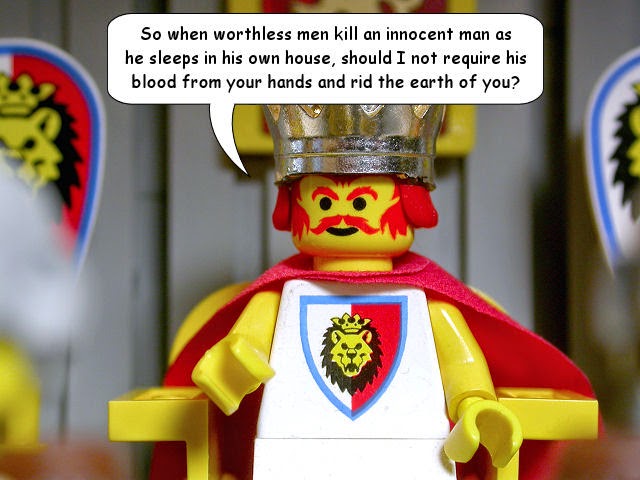
2 Samuel 16:11 "Let him alone and let him curse, for the Lord has told him." Sorrows multiplied upon the head of David during these dark days, sometimes quite literally. This chapter mentions two people from the house of Saul who used this opportunity to hurt David. The first is Ziba, Mephibosheth's servant, who tricked his lame master by leaving him behind in Jerusalem and following after David, saying that Mephibosheth hoped he would profit under Absalom's rule when really it was Ziba who temporarily profited by telling that hurtful lie. The second is Shimei, who flung  dirt and stones at David and his entourage as they passed by, cursing David and vengefully gloating over his misery. David's nephew Abishai wanted to take speedy vengeance on Shimei, but David forbade him with the highlighted words. Only a man after God's own heart could have uttered them. Shimei's words and deeds were wicked, but David recognized the very hand of God in what he did so far as his own soul was concerned. He received the cursing of that wretched man as part of the discipline through which God was bringing him. He expected that good would come out of it, as his next words reveal: "It may be that the Lord will look on the wrong done to me and repay me with good for his cursing this today." This is a radiant illustration of the deep and inward peace given to any man or woman living in fellowship with God in motive and desire. Such a person will receive all the sorrows that come to him or her as within the will of God and therefore intended ultimately for good and not evil. This sense of divine overruling will also cleanse the spirit of all desire for revenge. The New Testament rephrases the main principle like this: "We know that God causes all things to work together for good to those who love God" (Romans 8:28). Not all things are good, but those who love God (and only them) have the promise that bad, good, and everything in between will work together for their ultimate blessing.

2 Samuel 17:14 "The Lord had ordained to thwart the good counsel of Ahithophel so that He might bring calamity on Absalom." These words stand out revealingly at the center of strange and complex intrigue. Absalom is seen listening to two counselors. Ahithophel gave him shrewd military advice that would surely have given success to Absalom's rebellion, at least for the short term. David and his men on the run were were weary and had not yet time to organize so Ahithophel wanted Absalom to strike now and strike hard. Hushai, hoping secretly to protect David, gave  counsel that successfully appealed to Absalom's well-known vanity. He advised him to assemble a grand army and march out at the head of it to gain a glorious victory. That, of course, gave David and his experienced men the time they needed to set a trap for Absalom's army. Amid the complexities of human cleverness, the will of God is seen moving inexorably forward to accomplish His high purposes. God used Absalom's true nature to act in accordance with itself to bring about his utter defeat. This is one of the great principles of life that the Bible emphasizes and illustrates on every page: men and women cannot escape from God. They go their own way, but that way never sets them free from the authority and invincible power of God. Any way apart from God is always the wrong way and cannot lead to success.

2 Samuel 18:33 "Would that I died instead of you, O Absalom my son, my son!" Following Hushai's advice, Absalom delayed until he had gathered together a great army. That strategically was his undoing since David and his mighty men were now ready for them. Their forces met and fought exactly where David wanted: in the forest of Ephraim. Absalom was slain there and buried with dishonor by unscrupulous Joab, even though David clearly ordered for him to be dealt with gently. Joab's action was understandable from the standpoint of national security, but it broke David's heart. Everything in the story leads up to this highlighted wail of anguish over his dead boy. Five times David repeated the words "my son." More than a half-conscious repetition of words occasioned by personal grief, perhaps this father was truly realizing how much he was responsible for his son. It's as if David says, "Absalom is indeed my son: his weaknesses are my weaknesses, his passions are my passions, his sins are my sins." Out of that growing conviction came the deepest cry of all: "Would that I died instead of you!" Here surely David reached the profoundest moment of his suffering. May none of us ever experientially enter into its awful consciousness! In order that we may not, we need to ponder the whole story carefully to learn the solemn lessons it teaches about parental responsibility.

2 Samuel 19:30 "Oh, let him take it all, since my lord the king has come safely home!" This was the language of a glad heart. Mephibosheth had known the kindness of God through David when a regular place was made for him at the king's table. How he had suffered during the sad days of the king's forced absence from his own city! In his deep sympathy for David, he "neither cared for his feet, nor trimmed his mustache, nor washed his clothes, from the day the king departed until the day he came home in peace" (verse 24). Mephibosheth's suffering had been all the more acute because he had been prevented from accompanying his benefactor into exile by the treachery of Ziba, the servant who slandered him before David. Now Absalom's rebellion was over and David was able to return to his house. That was joy enough for the crippled son of Jonathan. He was willing for his enemy to have all the material things he gained by his lies. It was everything to him that his king should possess his kingdom in peace. What does this teach us about true loyalty? We who love the Lord have been given a place in the House of our King, at His table, in infinite grace—figuratively now, literally later. Is it more to us that He should have His rightful place than that we have even the things we have a right to because they are the King's gifts to us? Too often we are more concerned about our rights than about His. May our loyalty and love make us far more concerned about the victories of our Lord, as befits the attitude of all who sit at the King's Table.

2 Samuel 20:1 "We have no share in David, no inheritance in the son of Jesse; every man to his tents, O Israel!" This was the cry raised by an evil man who sought to divide the kingdom and create a position for himself. He cleverly disguised his intentions by tempting his countrymen to protest against a relatively minor social snub from the men of Judah. The roots of the trouble are in the previous chapter. Although the tribes of Israel were the first  to propose escorting the triumphant king back to Jerusalem, David's tribe—Judah—beat them to it as a matter of ethnic pride. On the way at Gilgal the tribes met and tempers flared. Occasion invariably finds a man for evil as well as for good, and our chapter introduces him with these words: "A base fellow happened to be there." Sheba was seeking personal aggrandizement so he took advantage of the situation. This new rebellion was defeated by the relentless Joab, who acted swiftly to quell the insurrection. Sheba's rallying cry teaches us that popular and plausible catchwords ought to be received and acted upon with great caution. Often there will be an element of truth in social complaints, but careful attention should be paid to the character of the men and women who voice them. Base, wicked agitators often make a just cause the occasion of seeking not its being made right, but bringing about some evil design that will subvert the highest interests of the people who complain. The fact that the Judahs of this world commit social blunders is no reason for kingdoms and governments to be disrupted. Injustice is never corrected by a yet deeper wrong.

2 Samuel 21:15 "David became exhausted." In these closing chapters of 2 Samuel, several matters are dealt with, not always chronologically but more as illustrations of the times that have been under consideration. These final records give further revelations of the direct government of God, two psalms of David that focus on God's character, and accounts of the great deeds of David's mighty men. The verse highlighted describes what happened during a battle near the end of David's reign. Fresh trouble arose from their old enemies the Philistines, who perhaps were emboldened by the internal rebellions David recently endured. Down went David with his army to fight against them, but he was no longer physically the man he had been. While in the fray his strength gave way and had it not been for the timely aide of his cousin Abishai, he would have been killed by one of the giant Goliath's descendants. This manifestation of weakness drew forth an expression of love from his people, who declared that he should no more go out to battle with them, lest he "extinguish the lamp of Israel" (verse 17). Thus at last all the strongest servants of the Lord come to the days of failure in physical strength. They can no longer endure the campaign; their old energy is no more. Happy indeed are those who in the days of full service find such a deep place in the hearts of God's people, their love gathers around them in thoughtfulness and care. Let those who, after long service, find themselves waning in strength be content to abide with the people of God, shining for them as a lamp to help them carry on the same divine enterprises. Such action in the last days of life is also great and high service.

2 Samuel 22:2 "The Lord is my Rock, my Fortress, and my Deliverer." In this chapter and the next we have two psalms of David, fittingly included in his life's story, for in them the true character of the man is strikingly revealed. The first, recorded in this chapter, is essentially the same as Psalm 18. It has six main divisions: 1. The Lord is declared to be the source of all strength (verses 2-4). 2. All deliverances are attributed directly to Him (verses 5-16). 3. Such deliverances come when His people obey His Word from the heart and live righteous lives as a result (verses 17-25). 4. A central principle of life is declared: God is to man what man is to God (verses 26-28). 5. David gives personal testimony to the truth of what he declared (verses 29-46). 6. He naturally concludes with a doxology, singing His thanks and praise to God (verses 47-51). Such convictions as these of the absolute sovereignty of God, His omnipotent power to deliver, the necessity for personal righteousness flowing from heartfelt obedience to God's Law, and the assurance that God will deliver His people when they follow Him—all this constituted the underlying strength of David's character. In the opening sentence, highlighted above, notice the personal nature of David's theology. All that this godly man celebrated in song was more than theory; it was experience. He had found the Lord to be indeed Rock, the sound foundation of his faith; Refuge, the safe place on the Rock; and Deliverer, the One who always guards the Refuge.

2 Samuel 23:5 "He has made an everlasting covenant with me, ordered in all things, and secured." According to the chronicler, this is David's last psalm, his last literary legacy to us. It has no equal in the Book of Psalms. In verses 1-4 David describes in exquisite language the true ideal of the godly ruler. Verse 5 hints that he has not realized that ideal, but declares  nevertheless that God is supremely faithful. Verses 6-7 are full of fire, solemnly pronouncing the fate of the wicked. This great man of faith, reaching the boundary of life where burdens are laid down, looks back over the way he has come and realizes that God's covenant with him has not only been kept, but has been "ordered in all things and secured." In God's dealings with His people, there are no mistakes, no lapses. Nothing has been permitted in our lives that has not been designed to serve the highest purpose. That is true even of our failures if, like David, in true repentance we have confessed and forsaken them. It is certainly so of all our sorrows and trials. Believing that our song at the end will celebrate this truth, happy are we to the degree we live now with this confidence. If we then expect to sing, "Right was the pathway leading to this," let us today sing, "Right is the pathway leading to that" so we may antedate heaven's joy and strengthen earth's pilgrimage.

2 Samuel 24:14 "Let us fall into the hands of the Lord, for His mercy is great; but do not let me fall into the hands of men." The Book of 2 Samuel closes with one final story revealing God's direct government by visiting the king and nation with punishment for numbering the people. A census is not wrong in itself and was commanded two times in the Book of Numbers, but we know this one was wrong from David's consciousness that it was so after he insisted on getting it done. Joab was aware this census had resulted from a wrong motive, for he said to David, "Now may the Lord your God add to the people a hundred times as many as they are, while the eyes of my lord the king still see; but why does my lord the king delight in this thing?" (verse 3). Pride in numbers had taken possession of the king and people, who forgot what David wrote earlier: "Some boast in chariots and some in horses, but we will boast in the name of the Lord our God" (Psalm 20:7). That is a persistent peril to all times and people. The choice David made regarding punishment reveals his deep sense both of the righteousness and tenderness of God. He willed that the stroke to come would be from the divine hand rather than any intermediary. How right he was since the Lord's chastisements come with no trace of personal vindictiveness! They are all restorative in their purpose and benevolent in their execution. The tender mercies of the wicked are cruel, sometimes in their leniency and sometimes in their brutality. The punishments of God are always merciful, sometimes in their severity and always in their perfect justice.