Translate

Showing posts with label John Bunyan. Show all posts

Thursday, October 24, 2013

Illustrated Summary of The Four Loves by C.S. Lewis—FRIENDSHIP

C.S. Lewis assigns 4 English words to 4 distinct Greek words translated love in the New Testament, with parenthetical clarification:
  • Storge = Affection (family love)
  • Philia = Friendship (friendship love)
  • Eros = Eros (erotic or sexual love)
  • Agape = Charity (divine love)

This post summarizes the chapter on Friendship with lively illustrations. 


Friendship

Few Modern Counterparts
C.S. Lewis begins, "When either Affection or Eros is one's theme, one finds a prepared audience. The importance and beauty of both have been stressed and almost exaggerated again and again.... Very few modern people think Friendship a love of comparable value or even a love at all. I cannot remember that any poem since In Memoriam, or any novel, has celebrated it. ["'Tis better to have loved and lost than never to have loved at all" is the most famous line from Tennyson's memorial to his college friend.] Tristan and Isolde, Antony and Cleopatra, Romeo and Juliet, have innumerable counterparts in modern literature: David and Jonathan...have not. To the Ancients, Friendship seemed the happiest and most fully human of all the loves; the crown of life and the school of virtue. The modern world, in comparison, ignores it. We admit of course that besides a wife and family a man needs a few 'friends.' But the very tone of the admission, and the sort of acquaintanceships which those who make it would describe as 'friendships,' show clearly that what they are talking about...is something quite marginal; not a main course in life's banquet; a diversion; something that fills up the chinks of one's time. How has this come about?

"The first and most obvious answer is that few value it because few experience it.... Friendship is...least natural of loves; the least instinctive, organic, biological...and necessary.... Without Eros none of us would have been begotten and without Affection none of us would have been reared; but we can live and breed without Friendship.... The pack or herd—the community—may even dislike and distrust it. Its leaders very often do.... This...quality in Friendship goes far to explain why it was exalted in ancient and medieval times and has come to be made light of in our own. The deepest and most permanent thought of those ages was ascetic and world-renouncing. Nature and emotion and the body were feared as dangers to our souls.... Inevitably that sort of love was most prized which seemed most independent...of mere nature.... But then came Romanticism and...the 'return to nature' and the exaltation of Sentiment...which, though often criticised, has lasted ever since. Finally, the exaltation of instinct....


"Other causes have contributed. To those...who see human life merely as a development and complication of animal life, all forms of behaviour which cannot produce certificates of an animal origin...are suspect.... That outlook which values the collective above the individual necessarily disparages Friendship: it is a relation between men at their highest level of individuality.... Some forms of democratic sentiment are naturally hostile to it....

"It has actually become necessary in our time to rebut the theory that every firm and serious friendship is really homosexual.... In some ways nothing is less like a Friendship than a love-affair. Lovers are always talking to one another about their love; Friends hardly ever about their Friendship. Lovers are normally face to face, absorbed in each other; Friends, side by side, absorbed in some common interest. Above all, Eros (while it lasts) is necessarily between two only. But two, far from being the necessary number for Friendship, is not even the best. And the reason for this is important.... 

"True friendship is the least jealous of loves. Two friends delight to be joined by a third, and three by a fourth, if only the newcomer is qualified to become a real friend. They can...say, as the blessed souls say in Dante, 'Here comes one who will augment our loves.'... In this, Friendship exhibits a glorious 'nearness by resemblance' to Heaven itself where the very multitude of the blessed (which no man can number) increases the [experience] each has of God. For every soul, seeing Him in her own way, doubtless communicates that unique vision to all the rest.... The more we thus share the Heavenly Bread between us, the more we shall all have....

"On a broad historical view it is...not the demonstrative gestures of Friendship among our ancestors [kisses, tears, and embraces regardless of gender] but the absence of such gestures in our own society that calls for some special explanation. We, not they, are out of step. I have said that...both the individual and the community can survive without [Friendship]. But there is something else, often confused with Friendship, which the community does need; something which is the matrix of Friendship. In the early communities the co-operation of the males as hunters or fighters was no less necessary than the begetting and rearing of children. A tribe where there was no taste for the one would die no less surely than a tribe where there was no taste for the other.... We men [got] together and [did] things. We had to. And to like doing what must be done is a characteristic that has survival value. We not only had to do the things, we had to talk about them. We had to plan the hunt and the battle. When they were over we had to...draw conclusions for future use. We liked this even better. We ridiculed or punished the cowards and bunglers, we praised the star-performers. We reveled in technicalities (...'I had a lighter arrowhead; that's what did it'...). In fact, we talked shop...all bound together by shared skill, shared dangers and hardships, esoteric jokes—away from the women and children.... They certainly often had rituals from which men were excluded....
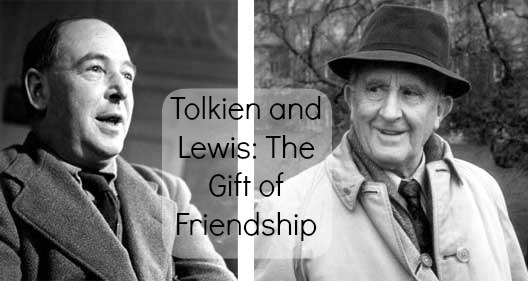
Details on Tolkien and Lewis's Friendship!
"This pleasure in co-operation, in talking shop, in the mutual respect and understanding of men who daily see one another tested is... something...we all understand.... I prefer to call it Companionship—or Clubbableness. This Companionship is, however, only the matrix of Friendship. It is often called Friendship, and many people when they speak of their 'friends' mean only their companions. But it is not Friendship in the sense I give to the word. By saying this I do not at all intend to disparage the merely Clubbable relation. We do not disparage silver by distinguishing it from gold. Friendship arises out of mere Companionship when two or more of the companions discover that they have in common some insight or interest or even taste which the others do not share and which, till that moment, each believed to be his own unique treasure (or burden). The typical expression of opening Friendship would be something like, 'What? You too? I thought I was the only one.'... Do you see the same truth?—Or at least, 'Do you care about the same truth?' The man who agrees with us that some question, little regarded by others, is of great importance can be our Friend. He need not agree with us about the answer....


Common Interest Needed
"People who simply 'want friends' can never make any. The very condition of having Friends is that we should want something else besides Friends. Where the truthful answer to the question Do you see the truth? would be 'I see nothing and I don't care about the truth; I only want a Friend,' no Friendship can arise—though Affection of course may. There would be nothing for the Friendship to be about; and Friendship must be about something.... Those who have nothing can share nothing; those who are going nowhere can have no fellow-travelers.


"When...two people who... discover...they are on the same secret road are of different sexes, the friendship which arises between them [may] very easily pass...into erotic love. Indeed, unless they are physically repulsive to each other or unless one or both already loves elsewhere, it is almost certain to do so sooner or later. And conversely, erotic love may lead to Friendship between the lovers. But this, so far from obliterating the distinction between the two loves, puts it into clearer light. If one who was first, in the deep and full sense, your Friend, is then gradually or suddenly revealed as also your lover you will certainly not want to share the Beloved's erotic love...but you will have no jealousy at all about sharing the Friendship. Nothing so enriches...as the discovery that the Beloved can deeply, truly and spontaneously enter into Friendship with the Friends you already had: to feel that not only are we two united by erotic love but we three or four or five are all travelers on the same quest, have all a common vision....

"It could be argued that Friendships are of practical value to the Community. Every civilised religion began in a small group of friends. Mathematics effectively began when a few Greek friends got together to talk about numbers and lines and angles.... Communism...Methodism, the movement against slavery, the Reformation, the Renaissance, might perhaps be said...to have begun in the same way.... But nearly every reader would probably think some of these movements good for society and some bad. The whole list, if accepted, would tend to show, at best, that Friendship is both a possible benefactor and a possible danger to the community....

"Others...would say that Friendship is extremely useful...to the individual. They could produce plenty of authority: 'bare is back without brother behind it' and 'there is a friend that sticketh closer than a brother.' But [that is] using friend to mean 'ally.' In ordinary usage friend means, or should mean, more than that. A Friend will, to be sure, prove himself to be also an ally when alliance becomes necessary; will lend or give when we are in need...because you would be a false friend if you would not.... The role of benefactor, [however], always remains accidental, even a little alien, to that of Friendship.... We are sorry that any gift or loan...should have been necessary—and now, for heaven's sake, let us forget all about it and go back to the things we really want to do or talk of together.... 'Don't mention it'...expresses what we really feel. The mark of perfect Friendship is not that help will be given when the pinch comes (of course it will) but that, having been given, it makes no difference at all....

"Friendship, unlike Eros, is uninquisitive. You became a man's Friend without knowing or caring whether he is married or single or how he earns his living. What have all these 'unconcerning things, matters of fact' to do with the real question, Do you see the same truth?... In a circle of true Friends...no one cares...about anyone else's family, profession, class, income, race, or previous history. Of course you will get to know about most of these in the end. But casually. They will come out bit by bit, to furnish an illustration or an analogy...never for their own sake. That is the kingliness of Friendship. We meet like sovereign princes of independent states, abroad, on neutral ground, freed from our contexts....

"Hence (if you will not misunderstand me) the exquisite arbitrariness and irresponsibility of this love. I have no duty to be anyone's Friend and no man in the world has a duty to be mine. No claims, no shadow of necessity. Friendship is unnecessary, like philosophy, like art, like the universe (for God did not need to create). It has no survival value; rather it is one of those things which give value to survival....

"The common quest or vision which unites Friends does not absorb them in such a way that they remain ignorant or oblivious of one another. On the contrary it is the very medium in which their mutual love and knowledge exist. One knows nobody so well as one's 'fellow.' Every step of the common journey tests his metal; and the tests are tests we fully understand because we are undergoing them ourselves. Hence, as he rings true time after time, our reliance, our respect and our admiration blossom into an Appreciative love of a singularly robust and well-informed kind. If, at the outset," we paid more attention "to him and less to the thing our Friendship is 'about,' we should not have come to know or love him so well. You will not" come to know "the warrior, the poet, the philosopher or the Christian by staring in his eyes as if he were your [mate]: better fight beside him, read with him, argue with him, pray with him.

"In a perfect Friendship this Appreciative love is, I think, often so great and so firmly based that each member of the circle feels, in his secret heart, humbled before all the rest. Sometimes he wonders what he is doing there among his betters. He is [blessed] beyond desert to be in such company. Especially when the whole group is together, each bringing out all that is best, wisest, or funniest in all the others. Those are the golden sessions; when 4 or 5 of us after a hard day's walking have come to our inn; when our slippers are on, our feet spread out towards the blaze and our drinks at our elbows; when the whole world, and something beyond the world, opens itself to our minds as we talk.... Affection mellowed by the years enfolds us. Life—natural life—has no better gift to give. Who could have deserved it?...

"In most societies at most periods Friendships will be between men and men or between women and women ... for they will seldom have had with each other the companionship in common activities which is the matrix of Friendship.... It is this lack, rather than anything in their natures, which excludes Friendship; for where they can be companions they can also become Friends. Hence in a profession (like my own) where men and women work side by side, or in the mission field, or among authors and artists, such Friendship is common. To be sure, what is offered as Friendship on one side may be mistaken for Eros on the other, with painful and embarrassing results. Or what begins as Friendship in both may become also Eros.... Sensible women...if they wanted, would certainly be able to qualify themselves for the world of discussion and ideas [as opposed to mainly narrative forms of communication].... If they are not qualified, [they] never try to enter it or to destroy it. They have other fish to fry. At a mixed party they gravitate to one end of the room and talk women's talk to one another. They don't want us, for this sort of purpose, any more than we want them. It is only the riff-raff of each sex that wants to be incessantly hanging on the other. Live and let live. They laugh at us a good deal. That is just as it should be.... No one ever really appreciated the other sex...without at times feeling them to be funny. For both sexes are. Humanity is tragi-comical....

"Friendship...love, free from instinct, free from all duties but those which love has freely assumed, almost wholly free from jealousy, and free from...the need to be needed, is eminently spiritual. It is the sort of love one can imagine between angels.... Let us beware.... There is spiritual evil as well as spiritual good. There are unholy, as well as holy, angels.... Three significant facts remain to be taken into account.
  1. The distrust Authorities tend to have of close Friendships among their subjects. It may be unjustified; or there may be some basis for it.
  2. The attitude of the majority towards all circles of close Friends. Every name they give such a circle is more or less derogatory: a set, a gang, or a mutual admiration society. Of course this is the voice of Envy. But Envy always brings the truest charge, or the charge nearest to the truth...it hurts more. The charge, therefore, will have to be considered.
  3. Friendship is very rarely the image under which Scripture represents the love between God and Men. It is not entirely neglected; but far more often, seeking a symbol for the highest love of all, Scripture ignores this seemingly almost angelic relation and plunges into the depth of what is most natural and instinctive. Affection is taken as the image when God is represented as our Father; Eros, when Christ is represented as the Bridegroom of the Church.

"Let us begin with the suspicions of those in Authority.... Alone among unsympathetic companions, I hold certain views and standards timidly, half ashamed to avow them and half doubtful if they can after all be right. Put me back among my Friends and in half an hour—in ten minutes—these same views and standards become once more indisputable.  The opinion of this little circle, while I am in it, outweighs that of a thousand outsiders. It is therefore easy to see why Authority frowns on Friendship. Every real Friendship is a sort of secession, even a rebellion. It may be a rebellion...of good men against the badness of society or of bad men against its goodness.... Men who have real Friends are less easy to manage or 'get at'; harder for good Authorities to correct or for bad Authorities to corrupt.... The element of secession, of indifference or deafness (at least on some matters) to the voices of the outer world, is common to all Friendships.... As I know I should be an Outsider to a circle of golfers, mathematicians, or motorists, so I claim the equal right of regarding them as Outsiders to mine. People who bore one another should meet seldom; people who interest one another, often. The danger is that this partial indifference or deafness to outside opinion, justified and necessary though it is, may lead to a wholesale indifference or deafness....

"But that is not all. The partial and defensible deafness was based on some kind of superiority—even if it were only a superior knowledge about stamps. The sense of superiority will then get itself attached to the total deafness. The group will disdain as well as ignore those outside it.... I have said that in a good Friendship each member often feels humility towards the rest. He sees that they are splendid and counts himself lucky to be among them. But unfortunately the they and them are also, from another point of view we and us. Thus the transition from individual humility to corporate pride is very easy.... I think we have all recognized some such tendency in...circles to which we are the Outsiders. I was once at some kind of conference where two clergymen, obviously close friends, began talking about 'uncreated energies' other than God. I asked how there could be any uncreated things except God if the Creed was right in calling Him 'the maker of all things visible and invisible.' Their reply was to glance at one another and laugh. I had no objection to their laughter, but I wanted an answer in words as well. It was not at all a sneering or unpleasant laugh. It expressed very much what Americans would express by saying 'Isn't he cute?'...

"We can detect the pride of Friendship—whether Olympian [tranquil and tolerant, making Outsiders feel like children], Titanic [militant and embittered against Outsiders], or merely vulgar [meant to make people feel like Outsiders]—in many circles of Friends. It would be rash to assume that our own is safe from its danger; for of course it is in our own that we should be slowest to recognize it.... Friendship must exclude. From the innocent and necessary act of excluding to the spirit of exclusiveness is an easy step; and thence to the degrading pleasure of exclusiveness.... The mass of the people, who are never quite right, are never quite wrong. They are hopelessly mistaken in their belief that every knot of friends came into existence for the sake of...conceit and superiority.... But they would seem to be right in diagnosing pride as the danger to which Friendships are naturally liable. Just because this is the most spiritual of loves the danger which besets it is spiritual too....

Safe Symbols
"Perhaps we may now hazard a guess why Scripture uses Friendship so rarely as an image of the highest love. It is already, in actual fact, too spiritual to be a good symbol of Spiritual things. The highest does not stand without the lowest. God can safely represent Himself to us as Father and Husband because only a lunatic would think that He is physically our sire or that His marriage with the Church is other than mystical. But if Friendship were used for this purpose we might mistake the symbol for the thing symbolised....


"Friendship, then, like the other natural loves, is unable to save itself.... Because it is spiritual and therefore faces a subtler enemy, it must...invoke the divine protection if it hopes to remain sweet. For consider how narrow its true path is. It must not become...'a mutual admiration society'; yet if it is not full of mutual admiration, of Appreciative love, it is not Friendship at all.... It must be for us in our Friendships as it was for Christiana and her party in The Pilgrim's Progress: 'They...could not see that glory each one on herself which they could see in each other. Now therefore they began to esteem each other better than themselves. For you are fairer than I am, said one; and you are more comely than I am, said another.' There is...only one way...we can taste this illustrious experience with safety. And Bunyan has indicated it in the same passage. It was in the House of the Interpreter, after they had been bathed, sealed and freshly clothed in 'White Raiment' that the women saw one another in this light. If we remember the bathing, sealing and robing, we shall be safe....

"In Friendship...we think we have chosen our peers. In reality, a few years' difference in the date of our births, a few more miles between certain houses, the choice of one university instead of another, posting to different regiments, the accident of a topic being raised or not raised at a first meeting—any of these chances might have kept us apart. But, for a Christian, there are, strictly speaking, no chances. A secret Master of the Ceremonies has been at work. Christ...can truly say to every group of Christian friends, 'You have not chosen one another but I have chosen you for one another.' The Friendship is not a reward for our discrimination and good taste in finding one another out. It is the instrument by which God reveals to each the beauties of all the others.... At this feast it is He who has chosen the guests. It is He, we may dare to hope, who sometimes does, and always should, preside. Let us not reckon without our Host. Not that we must always partake of it solemnly.... It is one of the difficult and delightful subtleties of life that we must deeply acknowledge certain things to be serious and yet retain the power and will to treat them often as lightly as a game."
Worth Reading Yourself!

Sunday, October 21, 2012

The Pilgrim's Progress—Part 2 with Christiana—Illustrated Quotes

The Pilgrim's Progress is one book with two distinct parts, like The Lord of the Rings is one book or story with three parts. Christiana, Christian's wife, acted like a villain in the first part but becomes the main heroine in the second part by leading her four sons and a neighbor to follow after Christian on  pilgrimage.


hristiana was glad in heart, "not only that she had a companion [her neighbor, Mercy], but also that she had prevailed with this poor maid to fall in love with her own salvation."


eliever said to Christiana after rescuing her group from ruffians, "I wondered that you did not petition the Lord for a guide to avoid these dangers, for He would have granted you one." Christiana responded, "Since our Lord knew it would be to our profit, I wonder that He sent not one along with us." Reliever answered, "It is not always best to grant things not asked for, lest by so doing they become of little esteem; but when the want of a thing is felt, it then receives in the eyes of him that feels it the estimate it properly is due.... 'Tis a poor thing that is not worth asking for"—not worth asking is not worth having. As James 4:3 says, "You do not have because you do not ask."
Great-heart, the Guide Worth Asking For


t the Interpreter's house "the water stood in Christiana's eyes, for she was a woman quick of apprehension." The eight lessons she learned there in Part 2 and the eight lessons Christian learned there in Part 1 are worth reading and pondering. My favorites are the man with the broom, the fire that could not be put out, the man with the muck-rake, and the valiant man who stormed the castle.


n the morning, they rose with the sun and began to prepare to go on their journey. But the Interpreter asked them to stay a little longer....Now, Innocent, following instructions, had them bathe in the pool of the garden, and put on new, white, linen clothing. Thus dressed, the women looked so beautiful that they looked on each other with awe. For each could see the glory only in the other, and each esteemed the other better than herself. "You are fairer than I," said one. "And you are more beautiful than I am," said the other. The children also stood amazed to see their new appearance.


fter successfully leading his company through the Valley of the Shadow of Death, Mr. Great-heart vanquishes Giant Maul, but came close to losing his life in the combat. Christiana asks, "Were you not afraid...when you saw him come out with his club?" Great-heart answers, "It is my duty to distrust my own ability that I may have reliance on Him who is stronger than all." Christiana then asks, "But what did you think when he knocked you down to the ground at the first blow?" His reply: "I realized that my Master, the Lord Jesus, was Himself treated the same way, yet He it was who conquered at the last." Christiana's eldest son, Matthew, says, "I think God has been wonderfully good to us both in bringing us out of this valley and in delivering us out of the hand of this enemy. For my part, I see no reason why we should distrust our God anymore since He has now, and in such a place as this, given us such testimony of His love as this." The pilgrim band then meet up with Old Honesty, and he and Great-heart soon discover that they are kindred spirits, possessed of valiant hearts.


ld Honesty replies to a query from Great-heart, "I would have fought as long as breath had been in me and had I done so, I would have prevailed. A Christian can never be overcome unless he yields himself." Great-heart joyfully responds, "Well said, father Honest, for by this I know you are a true Christian warrior because you have uttered a great Christian truth." Honesty answers, "And by what you said I know you understand the Christian pilgrimage because all others think that Christians are the soonest overcome of any." The meek are not weak but have their strength under control. It is folly to strive with the God behind that strength.


ast words uttered by Christiana and company in turn when the Master was not willing that they should be so far from Him any longer:
  • Christiana says, "I come, Lord, to be with You and bless You."
  • Mr. Ready-to-halt says, "Welcome, life!"
  • Mr. Feeble-mind says, "Hold out, faith and patience."
  • Mr. Despondency says, "Farewell, night! Welcome, day!"
  • Old Mr. Honest says, "Grace reigns."
  • Mr. Valiant-for-truth says, "I am going to my Father's House, and though with great difficulty I have reached this point, yet now I do not repent of all the trouble I have been through to arrive where I am. My sword I give to him who shall succeed me in my pilgrimage, and my courage and skill to him who can get it. My marks and scars I carry with me to be a witness that I have fought the battles of Him who now will be my Rewarder.... Death, where is your sting? Grave, where is your victory?"
  • Mr. Stand-fast says, "I see myself now at the end of my journey. My toilsome days are ended. I am now going to see that head that was crowned with thorns, and that face that was spit upon for me. I have formerly lived by hearsay and faith, but now I go where I shall live by sight, and shall be with Him in whose company I delight. I have loved to hear Him spoken of, and wherever I could see His footprints on the sands of time, there I delighted to walk. His name has been to me a precious treasure—sweeter than all perfumes. His voice I rejoice to hear, and His face to me exceeds all beauty in earth and sky. His Word I have used as food  for my soul and for antidotes against my faltering. He has kept me back from my iniquities, and He has held me fast. Yes, my steps He has strengthened in His way. Take me, Lord, for I come to Thee."
  • See also The Pilgrim's Progress, Part 1 with Christian—Illustrated Quotes


Saturday, October 20, 2012

The Pilgrim's Progress—Part 1 with Christian—Illustrated Quotes

 
The Pilgrim's Progress may be my second favorite book after the Holy Bible because of its accuracy and honesty in describing the Christian life in memorable story form. When making a pilgrimage through the book recently, I decided to highlight poignant quotes that follow the story's chronology:

 
Christian with the Book by Him Who Cannot Lie


hristian, at the beginning of his pilgrimage, fields this question from Pliable: "Do you think that the words of your Book are certainly true?" Christian answers, "Yes, for it was made by Him who cannot lie."
 
he first thing Interpreter shows to Christian in his wonderful house of life lessons is the pastor's portrait, who "had eyes lifted to heaven, the best of books in his hand, the Law of truth written upon his lips, the world ... behind his back. It stood as if it pleaded with men, and a crown of gold did hang over his head.... His work is to know and unfold dark things to sinners." Interpreter tells Christian, "I have showed you this picture first because the [pastor] ... is the only man whom the Lord of the place to where you are going has authorized to be your guide in all difficult places you may meet with in the way."
  
Christian Loses His Burden at the Cross
 
hristian journeyed for a long way with the increasingly heavy burden of sin on his back. He knew many biblical truths, but until this point in his pilgrimage he was missing the key truth. Only when Christian on the Narrow Way "came up to the Cross [was] his burden loosed from off his shoulders. [It] fell from off his back and began to tumble, and so continued to do, till it came to the mouth of the Sepulcher, where it fell in, and I saw it no more. Then was Christian glad and felt light as a feather. He said with a merry heart, 'Jesus has given me rest by His sorrow, and life by His death.'" He receives spiritual gifts and assurances at this turning point in his journey, reflecting his full trust in the work of Christ on the cross alone to procure his salvation in life and death.
Christian Receives the Key of Promise


aithful to Talkative: "When Christ said, 'Do you know all these things?' and the disciples had answered, 'Yes'; He added, 'Blessed are you if you do them.' He did not lay the blessing in the knowing of them but in the doing of them."


hen Christian and Hopeful strayed from the straight Way, which was difficult in some parts, onto soft, easy By-path Meadow, they later heard, "'Let your heart be towards the highway, even the way that you went; turn again.' But by this time the waters were greatly risen so the way of going back was very dangerous. (Then I thought that it is easier going out of the way when we are in than going in when we are out.)"


hristian and Hopeful were then captured by Giant Despair, who made life miserable for them. The giant taunted them, repeatedly saying, "Why .. .should you choose life, seeing it is attended with so much bitterness?" Christian was now depressed enough to agree but Hopeful told him, "Indeed our present condition is dreadful ... but ... the Lord of the country to which we are going has said, 'You shall do no murder.'... Moreover, my brother, you talk of ease in the grave, but have you forgotten the hell to which ... murderers go? For 'no murderer has eternal life.'... The time may come that may give us a happy release." That time came when "Christian, as one half amazed, broke out in this passionate speech: 'What a fool I am to lie in a stinking dungeon when I may as well walk at liberty! I have a key in my pocket called Promise that will, I am persuaded, open any lock in Doubting Castle.'" It did indeed!


hen Christian and Hopeful reached the Delectable Mountains, they leaned on their walking staffs and spoke with the kindly shepherds there, named Knowledge, Experience, Watchful, and Sincere, who taught them some of the lessons of the land. Then said the pilgrims to one another, "We have need to cry to the Strong for strength!" The shepherds replied, "Aye, and you will have need to use it when you have it, too."


orced to travel where they dare not fall asleep, Christian and Hopeful kept each other awake with good conversation about how Hopeful began to be concerned about the state of his soul. He told Christian, "For a long time I enjoyed those things that .. .I believe now, would have (had I continued in them) destroyed me ... all the treasures and riches of the world. I also delighted in debauchery, partying, drinking, swearing, lying, immorality, Sabbath-breaking, and every other thing that tends to destroy the soul. But by hearing and considering divine things, which I learned about you, as well as from beloved Faithful, who was put to death at Vanity Fair for his faith and goodness, I discovered at last that 'the end of those things is death' (Romans 6:21).... I tried not to sin, and I avoided sinful company ... but then my trouble came tumbling upon me again, despite all my changes." Hopeful thought he was basically a good person, but his opinion about himself began to change when he started taking seriously such sayings as these: "All our good deeds are as filthy rags" (Isaiah 64:6), "By the works of the Law no one shall be justified" (Galatians 2:16), and "When you have done all things, say 'We are unprofitable'" (Luke 17:10). "I thought to myself," said Hopeful, "If all my good deeds are like filthy rags in God's sight, if no one can be justified by obeying the Law, and if, when we have done all we can, we are still unworthy, then it is foolish to think we can get to heaven by our good works. Furthermore I thought that if a man runs up a bill of a hundred pounds with a shopkeeper and after that he pays for everything he buys but still owes his old bill, the shopkeeper can still sue him and send him to prison until he pays the debt.... I have by my sins run up a great charge in God's Book, and my reforming now will not pay off that debt.... How shall I be freed from the damnation I have brought upon myself by my former transgressions?" Another thing that weighed upon his mind was this: "If I look carefully at the best of what I do now, I still see sin, new sin, mixing itself with the best of what I do so I am forced to conclude that, even if my former life had been faultless, I have now committed sin enough in one action to send me to hell."   The apostle Paul wrote about the same experience: "I have discovered this principle of life—that when I want to do what is right, I inevitably do what is wrong" (Romans 7:21). The breakthrough for Hopeful (and countless others) came when realized that "Christ Jesus came into the world to save sinners" (1 Timothy 1:15). "He is the end of the Law for righteousness to everyone who believes" (Romans 10:4). "He died for our sins and rose again for our justification" (Romans 4:25). "He is the mediator between God and us" (1 Timothy 2:5). "I gathered from all these Scriptures," said Hopeful, "that I must look for righteousness in His person and for satisfaction for my sins through His blood.... Now my heart was filled with joy, my eyes filled with tears, and my heart brimming over with love for the name, people, and ways of Jesus Christ."


opeful and Christian meet a young man named Ignorance, who assumes he will go to heaven someday because he is pleased with his own views. He is not at all open to hearing otherwise. That leads to a discussion of what causes people to be like that or to profess faith in Christ, but then backslide or fall away. Hopeful observes that though the consciences of such people are awakened, "their minds are not changed; therefore, when the guilt passes, they cease to be religious.... Thus they are eager for heaven only because they fear the torments of hell, but as soon as their sense of hell and their fears of damnation chill and cool, so does their desire for heaven and salvation ... and they return to their old course again. Another reason is that they are slaves to certain fears that overpower them; particularly the fear of men, for 'the fear of men brings a snare' (Proverbs 29:25).... The stigma that surrounds religion is also a stumbling block to them.... Because they shun even the thoughts of guilt and fear, when once they are rid of their concerns about ... the wrath of God, they gladly harden their hearts and choose ways that will harden them more and more." Christian then discusses how "the hardening of heart takes place: 1. As much as they can, they turn their thoughts away from any reminder of God, death, and judgment to come. 2. Then they gradually cease their private duties, such as prayer, restraining their lusts, and being vigilant and repentant regarding sin. 3. Then they shun the company of lively and sincere Christians. 4. After that they grow indifferent to public duties such as hearing and reading the Word, gathering together for worship, and the like. 5. Then they begin to find fault with some of the godly, and the devilish purpose behind this is to find some alleged reason for turning away from faith in Christ. 6. Then they begin to associate with worldly and immoral people. 7. Then they indulge in worldly and lewd conversations, and are happy if they can find any who are considered honest doing the same so they may use their example as an excuse to indulge more boldly. 8. After this they begin to play with little sins openly. 9. And then, being hardened, they show themselves as they really are. Launched into a gulf of misery, they are lost forever in their own deception unless a miracle of grace prevents it."

ater on, when crossing the River of Death, Hopeful calls out, "Be of good cheer, my brother: I feel the bottom and it is good!" Christian, remembering old sins, is tempted to forget that God already forgave them all through Christian's faith in Christ, so he struggles in the River. Hopeful encourages him again, saying, "Be of good cheer: Jesus Christ makes you whole!" Christian then calls out loudly, "Oh! I see Him and He tells me, 'When you pass through the waters, I will be with you; and ... they shall not overflow you.' Then they both took courage and the Enemy was after that as still as a stone."


wo shining ones (angels) greet Christian and Hopeful on heaven's side of the River of Death, explaining, "We are ministering spirits, sent forth to minister to the heirs of salvation." Christian and Hopeful "left their mortal garments behind them in the River, for though they went in with them, they came out without them. They therefore went up with much agility and speed....The talk they had with the shining ones was about the glory of the place.... 'There,' said they, 'is ... the paradise of God.... Your walk and talk shall be every day with the King, even all the days of eternity. There you shall not see again such things as you saw when you were in the lower region upon the earth ... sorrow, sickness, affliction, and death.... You are now going to Abraham, Isaac, and Jacob, and to the prophets—people who are now resting upon their beds, each one walking in his or her righteousness.' The men then asked, 'What must we do in the holy place?' To whom it was answered, 'You must there receive the comforts of all your toil, and have joy for all your sorrow; you must reap what you have sown, even the fruit of all your prayers, and tears, and sufferings for the King by the way. In that place you shall ... enjoy the perpetual sight and vision of the Holy One, for there you shall see Him as He is. There also you shall serve Him continually with praise.... You shall enjoy your friends again who have gone there before you; and there with joy you will greet those who  follow into the holy place after you. There you shall be clothed with glory and majesty, and made fit to ride out with the King of Glory. When He shall come with sound of trumpet in the clouds, as upon the wings of the wind, you shall come with Him; and when He shall sit upon the throne of judgment, you shall sit by Him; yea, and when He shall pass sentence upon all the workers of iniquity, let them be angels or men, you also shall have a voice in that judgment, because they were His and your enemies. And when He shall again return to the city, you shall go too, with sound of trumpet, and be ever with Him.'"
A Glimpse of the Celestial City

See also:
* The Pilgrim's Progress, Part 2 with Christiana—Illustrated Quotes

* For an overview, see 10 Things You Should Know About Pilgrim's Progress

*The beautifully animated film The Pilgrim's Progress | Official Trailer (2019)

* "The Progressive Pilgrim," an article summarizing Nathaniel Hawthorn's clever satire of weak attempts to modernize The Pilgrim's Progress