Translate

Showing posts with label Manual Labor. Show all posts

Tuesday, February 22, 2022

1 THESSALONIANS+—An Illustrated Summary of Life Applications from Every Chapter of the Bible by G. Campbell Morgan

"On every page of the God-breathed writings are many thoughts that stretch out like long, clear arms of light across the darkness, discovering things otherwise hidden and illuminating wider areas than those of the immediate context. They are searchlights. I have selected one in each chapter of Scripture, for at least one central thought in every chapter should arrest the mind and affect the life," wrote G. Campbell Morgan, a skilled, wise, warm-hearted Bible teacher who conducted a classic 3-year study called Life Applications from Every Chapter of the Bible. Here is the fruit of that research—summarized, illustrated, and amplified with useful details—on all 66 books of the Bible.


1 Thessalonians 1:9-10 "You turned ... to serve ... and to wait." Paul's first letter to the church at Thessalonica in Greece is perhaps the first New Testament letter Paul wrote. He encourages new believers in their faith, exhorts them to godly living, assures them about the eternal state of believers who had died, and defends the integrity of his ministry as an apostle. This first chapter represents a church living out the essentials of the Christian faith. Paul begins by commending these fellow Christians for their faith, love, and hope, which they eagerly shared with the people around them. The word spread, Paul happily reports, about how they "turned to God from idols to serve the living and true God, and to wait for His Son from heaven, whom He raised from the dead, Jesus who delivers us from the wrath to come." That is a beautiful and practical example of what true repentance looks like: not just turning from evil, like some mere private reformation, but also turning toward God, patiently trusting and obeying Him for the rest of our lives, knowing He will protect and reward us in due time.
1 Thessalonians 2:7 "We were gentle among you, like a nursing mother taking care of her own children." This merging of trained, intelligent nursing skill with the tender love of a mother for her children is how Paul and his fellow ministers cared for these new believers. As they grew, they received the love of a father as well. Paul reminds them, "You know how, like a father with his children, we exhorted each one of you and encouraged you to walk in a manner worthy of God." Like good parents, these spiritual  mothers and fathers worked day and night so that they would not be a burden on their spiritual children. Their efforts bore good fruit. Paul could write from the heart, "We thank God constantly that  when you heard the Word of God from us, you accepted it not as the word of mere men, but as what it really is: the very Word of God, which is at work in you believers.... What is our hope or joy or crown of boasting before our Lord Jesus at His coming? Is it not you? For you are our glory and joy." Are we investing our lives in the lives of other believers in a way that will make Jesus glad at His return?
1 Thessalonians 3:3 "You yourselves know that we are appointed for this." Paul is referring to afflictions, not only that the Thessalonian believers were experiencing, but also what they were distressed to hear that Paul and company were going through. Surveying the whole Christian movement, he saw suffering everywhere as the result of loyalty to faith in Christ, but he did not think of it merely as something to be endured. He saw God ruling over all. The word appointed above reflects that. As the sufferings of Christ were all "according to the definite plan and foreknowledge of God" to accomplish His redemptive purpose, so all the afflictions of those who follow Christ are united in the same fellowship with Him to the glorious culmination of history. Paul received word that these believers were remaining faithful to Christ despite their troubles. His response? "Now we really live since you are standing firm in the Lord! How can we thank God enough for you in return for all the joy we have in the presence of God because of you?.... Now may our God and Father Himself and our Lord Jesus clear the way for us to come to you. May the Lord make your love increase and overflow for each other and for everyone else, just as ours does for you. May He strengthen your hearts so that you will be blameless and holy in the presence of our God and Father when our Lord Jesus returns with all His holy ones."
1 Thessalonians 4:11-12 "Aspire to live quietly, mind your own business, and work with your hands so that your daily life may win the respect of outsiders." This chapter famously covers immediate practical matters like this and also gives a thrilling glimpse of the future when Jesus returns, spelling out how that impacts both the living and the dead. It begins with this clear declaration of God's will: "Abstain from sexual immorality. Each of you must learn to control his own body in holiness and honor ... that no one wrongs his brother or sister in Christ in this matter because the Lord is an avenger in all these things, as we told you beforehand and solemnly warned you." That should strike terror in the hearts of the unfaithful, but not the faithful, whom Paul and his co-laborers comfort like this: "Brothers and sisters, we do not want you to be uninformed about those who sleep in death.... God will bring with Jesus those who have fallen asleep in Him.... The Lord Himself will come down from heaven with a loud command ... and the trumpet call of God. The dead in Christ will rise first. After that, we who are still alive will be caught up together with them in the clouds to meet the Lord in the air [an event known as the Rapture]. And so we will be with the Lord forever. Therefore encourage one another with these words."
1 Thessalonians 5:16-17 "Rejoice always, pray without ceasing, in everything give thanks." These 3 commands on the last page of this letter correspond with the 3 key marks of the Christian faith that open it: faith, hope, and love. In faith, the Thessalonian believers had turned to the living God from dead, empty idols, giving them cause to "rejoice always." In labors of love they were serving their gracious Lord, which would be sustained by their praying as a way of life without ever abandoning the practice. In their patient hope they were waiting for Jesus to return and make all things right, giving thanks in the midst of all kinds of circumstances, good and bad. Paul also says, "We urge you, brothers and sisters, admonish the idle, encourage the fainthearted, help the weak, be patient with them all. See that no one repays anyone evil for evil, but always seek to do good to one another and to everyone." He later would write something similar to the Galatian Christians: "Let us not grow weary of doing good, for in due season we will reap a harvest if we do not give up. As we have opportunity, let us do good to everyone, especially to those who are of the household of faith" (Galatians 6:9-10). Paul closes his first apostolic letter with encouragement, writing, "Now may the God of peace Himself sanctify you completely, and may your whole spirit and soul and body be kept blameless at the coming of our Lord Jesus Christ. He who calls you is faithful; He will surely do it."

Sunday, January 9, 2022

Illustrated Summary of The Chosen: Season 2, Episode 2: I Saw You


We are introduced to two apostles in this episode. The first is Nathanael, represented as an ambitious and conscientious architect who suffers a catastrophic professional setback.

Philip is represented as a disciple of John the Baptizer sent by John to follow Jesus. Philip soon displays an impressive knowledge of Scripture, wisdom, and kindness. When Simon mocks Matthew for looking for wood where it is wet, Philip teaches Matthew how to dry wood, but first recites a stirring text from Ezekiel when Israel will make firewood from the weapons of enemies. Some of the other disciples who went to Hebrew school join in the recitation, inspiring the others to want to learn more of God's Word for themselves. 
As Philip walks with Matthew, he inquires about the reason for Simon's hostility toward him. Matthew tells him he was a tax collector, a fact that Philip literally takes in stride, which surprises Matthew enough to ask, "That doesn't shock you?" Philip says, "I 'was' something else once, too. Once you've met the Messiah, 'am' is all that matters. Next time Simon rides you, remind him that the people out there want to define us by our past. Our sins." "Out where?" inquires Matthew. "Out there, with the sleepers. But we're different: we're awake," says Philip, using an analogy that appears often in the Bible. He further explains that men act by men's standards and are playing by a different game than Jesus's followers. Matthew has a hard time understanding these word pictures. Philip encourages him, saying he will probably pick up these concepts faster than the rest in time. Matthew draws a circle in the ground to show how he feels like an outcast. Philip relates, but says, "You're fine, Matthew. Stick aroundyou're going to be all right."
Philip speaks of new life in Christ.

Nathanael slowly approaches a fig tree in a remote spot. He sits under the tree and opens his satchel, looking over his architect renderings of a job that literally fell apart for him. He starts a fire and consigns them to the flames mournfully, pouring out his heart to God, whom he earnestly desired to serve with his skills. With his tears running over and obviously experiencing the worst day of his life, Nathanael begins to recite Psalm 102, "a prayer of one afflicted, when he is faint and pours out his complaint before the Lord: Hear my prayer, O Lord; let my cry come to You! Do not hide Your face from me in the day of my distress! Incline Your ear to me; answer me speedily in the day when I call!" Nathanael asks out loud if God sees him, but hears nothing. He stays until darkness approaches, pouring ashes from the dead fire over his head in deep lamentation. With resignation he gets up and walks away.
Nathanael approaching a fig tree.
Earlier, as Philip and Matthew work together to prepare the wood to be suitable for burning, Philip teaches Matthew how to work efficiently on the job. Matthew is grateful, remarking, "I've never done manual labor before!" Philip quips, "You must have worked hard to avoid it, but all that is behind you now. You've got to lean into it. Let someone teach you a thing or two. Laugh at someone's jokes and then tell some. Do you know any?" Matthew does not so Philip again seeks to help his new friend, who feels the sting of not being liked. Philip tells him, "If Rabbi Jesus of Nazareth has called you, it means you already have everything you need for right now. He'll give you the rest in time." Matthew wonders what Jesus sees in him, knowing He is a religious teacher but that he himself knows very little about religion. Philip says, "From what I understand, Jesus doesn't love everything about religion. Matthew, what you think you know doesn't matter. Only that Jesus chose you. That's where your confidence comes from now."
Learning to enjoy manual labor.
Later, as Matthew and the others sleep, Philip tends the fire. Jesus approaches and the two greet one another warmly. Jesus says, "Follow Me" and Philip says, "I will." They discuss where the ministry will take them. That includes insight on one of the reasons Jesus felt compelled to seek solitude in prayer throughout His ministry. Jesus tells Philip He has had much on His mind, requiring careful thought on how best to explain what and when in His preaching. When Philip learns they are on their way to minister on the outskirts of Syria and will be passing near where a friend lives, he asks the Lord if he may take the time to see him. Jesus responds, "Listen, if we don't make time for friends, we won't have any." 

In the morning, Mary Magdalene and Ramah talk about the adjustments they're learning to make to life on the road, and decide to put their time to good use by learning Scripture. (Soon Mary will be borrowing writing materials from Matthew to teach Ramah to read and write with passages Matthew will get from Philip.) The disciples are learning to help each other as they help others in service to Christ.
Andrew runs to take his turn pushing the big cart.
On the road the disciples take turns pushing their big cart, with Big James having the longest shift because of his size. Simon organizes the labor swaps and sends out Andrew to replace Big James. Jesus says, "I'll be up next, Andrew." Simon protests, but Jesus says, "Let me tell you something: Some days I miss manual labor. Fewer questions, less speculation, honest sweat." Simon brings up the subject of having a more formal structure for their group, especially when Jesus leaves them to be alone. Jesus answers, "I love how you are trying to make things better for the whole group. You could stand to be a little nicer sometimes. But you're a leader: you always have been and always will be. I cherish that and will need it in time. Every one of these people I have called for a reason. Each of them brings something unique and important to the whole. I want every voice heard and none silenced. Everyone can learn from each other." Simon says, "Yes, but some people are troubled with tiny things and they slow us down." Jesus responds, "If someone is thinking things that you feel slow everyone down, maybe you need to slow down. One day, Simon, there will need to be more structure." Simon wants to know why not now, and Jesus says it's because He's still with them. Stunned, Simon wants to know if one day He won't be. "That's a conversation for another time," says the Lord. Simon wants it to be soon. Jesus observes that soon is a most imprecise word, for it can mean a few minutes, hours, days or a thousand years. "Ask My Father in heaven how long a thousand years is. Then talk to Me about soon," Jesus says with a friendly slap to Simon's shoulder as He runs off to relieve Andrew on the cart.

As the group walks along, Matthew asks Philip about Scripture passages to memorize to make up for lost time. Philip responds, "No, Matthew, you didn't lose any time. It just got rearranged. You're gaining it all back now." Matthew says, "But in the meantime I want to understand the same things you do and everyone else." "It doesn't happen overnight," remarks Philip, who then promises to think about a good passage for Matthew to start memorizing. He excuses himself to run on ahead to the approaching town to find the friend he told Jesus about.

Philip crawls through a window to get to Nathanael, whom he finds in bed and despondent. A cup of water and good conversation help Nathanael revive. Despite hearing of the construction accident and Nathanael getting fired from his architect job, Philip says, "I'm proud of you. I've lived through you at times. Do you know that? I mean the part of building something with your own hands. I had a calling and I don't regret it, but while you were in the city being validated by top professionals, I was in the wilderness with a lot of yelling. You had actual physical evidence to show for your efforts." "A pile of rubble," replies Nathanael. Philip says, "You don't know what your impact was or will be. I thought I knew where God was putting me, too. John sent me to someone new. He's not just anyone. This is who the baptizer has been preparing us for. Nathanael, He's the Onethe One that Moses foretold and the prophets said would come: Jesus of Nazareth, the son of Joseph." Nathanael scoffs at the idea of anyone important coming from a small town like Nazareth, but Philip simply says, "Come and see. Your whole life you've wanted to serve God, to meet the Son of God, the King of Israel. I promise you will not regret it. I know you: you don't mess around; you will want to join Him. He's like no Rabbi who ever has been or will be." Nathanael is struck by never hearing Philip speak like this before, so he decides to come and see.
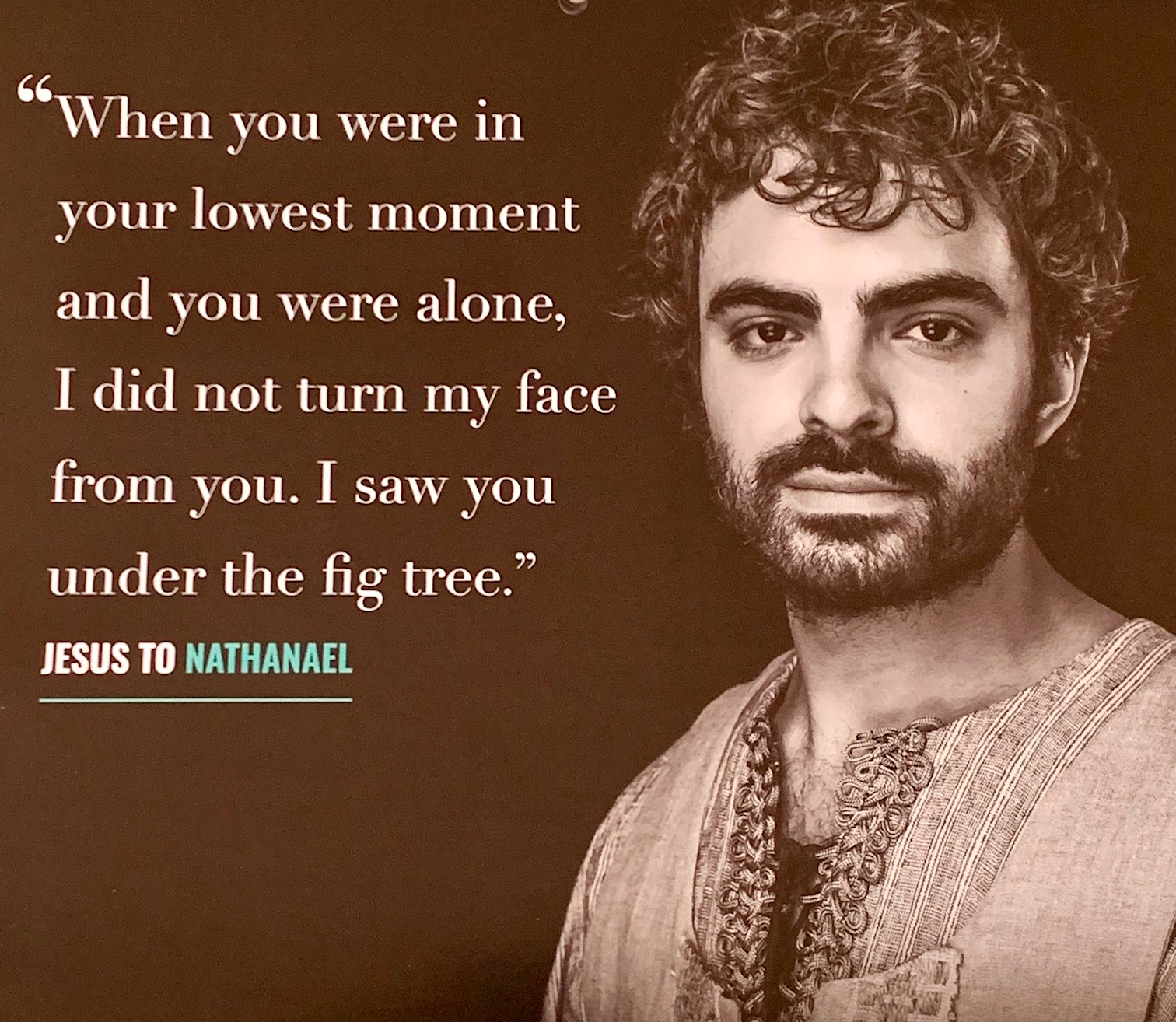
Jesus sees them coming toward Him in the night and says, "It is a good night!" Then He catches Nathanael off guard when He says to Philip and then Nathanael, "Do you know who that is standing next to you? The truth teller! Man is often deceitful, and Israel began with Jacob, a bit of a deceiver, yes? But one of the great things about you is you are a true Israelite, in whom there is no deceit." Nathanael says abruptly, "What is this? How do you know me?" Jesus answers truthfully, "I have known you long before Philip called you to 'come and see.' Don't look at him; look at Me. When you were in your lowest moment and you were alone, I did not turn My face from you. I saw you. Under the fig tree." Nathanael immediately comes to the right conclusion: "Rabbi, You are the Son of God, the King of Israel." Philip laughs, saying "I knew it!" and Jesus says, "Well, that didn't take long. Because I said to you I saw you under the fig tree, you believe?" Placing His hand on Nathanael's shoulder in an affirming way, He continues, "You are going to see many greater things than that. Like Jacob, you are going to see heaven opened, and the angels of God ascending and descending upon the Son of Man. That's Me, by the way." Nathanael says, "Yeah, I got that!" "Good!" says Jesus, "I know you like to be clear."

Peter and Andrew run up, apologizing for the interruption, but excited to report to Jesus, "Your fame is spreadingthe good kind!" The poor and the sick are already gathering nearby in Syria, eager to listen to Jesus and be healed by Him. After giving thanks for that report, Jesus turns to Nathanael and says, "So you wanted to help build something that would cause prayer and songs. Something to bring souls closer to God, yes? Can you start tomorrow?"
Best job offer ever!